NVIDIA Nemotron 3 Diarization: Ever wished your AI could not just understand *what* people are saying, but also *who* is saying it, all in real-time? Well, get ready, because NVIDIA Nemotron 3 Diarization is making that a reality for everyday creators and developers. This isn't just about transcribing words; it's about giving your AI applications the superpower to identify and label different speakers as they talk, live! 🎙️
In this post, we're going to demystify NVIDIA's latest advancements, specifically how their Streaming Sortformer model integrates with Nemotron ASR to deliver real-time, multi-speaker audio processing. We'll explore what it means for your projects, how it works, and how you can start building more intelligent, interactive AI applications today. You'll walk away understanding how to leverage this powerful tech without needing a PhD in AI.
Advertisement
What is Real-Time Speaker Diarization, Anyway? 🤔
Imagine you're in a video call with several people, and an AI is taking notes. Speaker diarization is the magic that tells the AI, "Okay, *this* person just said that, and *that* person responded." It's the process of figuring out who spoke when. When we add "real-time" to it, it means this identification happens *as* people are speaking, with minimal delay.
For creators and small businesses, this is huge. Think about automated meeting minutes that actually know who said what, or customer service bots that can differentiate between a customer and a support agent in a live conversation. It transforms raw audio into structured, speaker-attributed data, making your AI applications much smarter and more useful. NVIDIA's Streaming Sortformer model is at the heart of this real-time capability, designed specifically for these dynamic, live scenarios.
NVIDIA's Secret Sauce: Streaming Sortformer & Nemotron ASR 🧪
NVIDIA has cooked up a powerful combination: the Streaming Sortformer diarization model working hand-in-hand with their Nemotron ASR (Automatic Speech Recognition) streaming pipeline. Think of Nemotron ASR as the brain that turns speech into text, and Streaming Sortformer as the detective that identifies each voice.
This isn't just two separate tools bolted together. They're integrated directly through the Riva SDK, NVIDIA's platform for building and deploying AI speech services. This tight integration means you get live, diarized transcripts with speaker labels, all designed for low latency. It’s built for those moments where every millisecond counts, like a live Q&A session or an interactive voice assistant.
🟦 Streaming Sortformer: The Speaker Detective
This model is specifically engineered for real-time performance. It analyzes the unique characteristics of each voice to determine distinct speakers. It's smart enough to handle new speakers joining a conversation and assigns them a label on the fly. This is crucial for dynamic environments where you can't pre-train for every possible voice.
🟥 Nemotron ASR: The Transcription Engine
Nemotron ASR is NVIDIA's powerhouse for speech-to-text. When combined with Streaming Sortformer, it doesn't just give you a wall of text; it provides a beautifully organized transcript where each sentence or phrase is attributed to a specific speaker. This makes the output immediately actionable and understandable for your applications.
The Nitty-Gritty: Latency and Speaker Support ⏱️
When we talk about "real-time," latency is always a big question. NVIDIA's system is designed for low latency, but it's important to understand that there's always a tiny bit of processing time. Specifically, the system exhibits some inherent transition latency—a few hundred milliseconds—after a speaker change. This slight delay allows the system to confidently assign a new speaker label.
This isn't a bug; it's a feature! It ensures accuracy. For most interactive AI applications, a few hundred milliseconds is perfectly acceptable and won't disrupt the flow of conversation. The system is also quite capable, supporting up to four speakers simultaneously. And here's a bonus: it works across all 25 languages supported by Nemotron ASR, with English performance being particularly optimized. So, your global projects are covered! 🌍
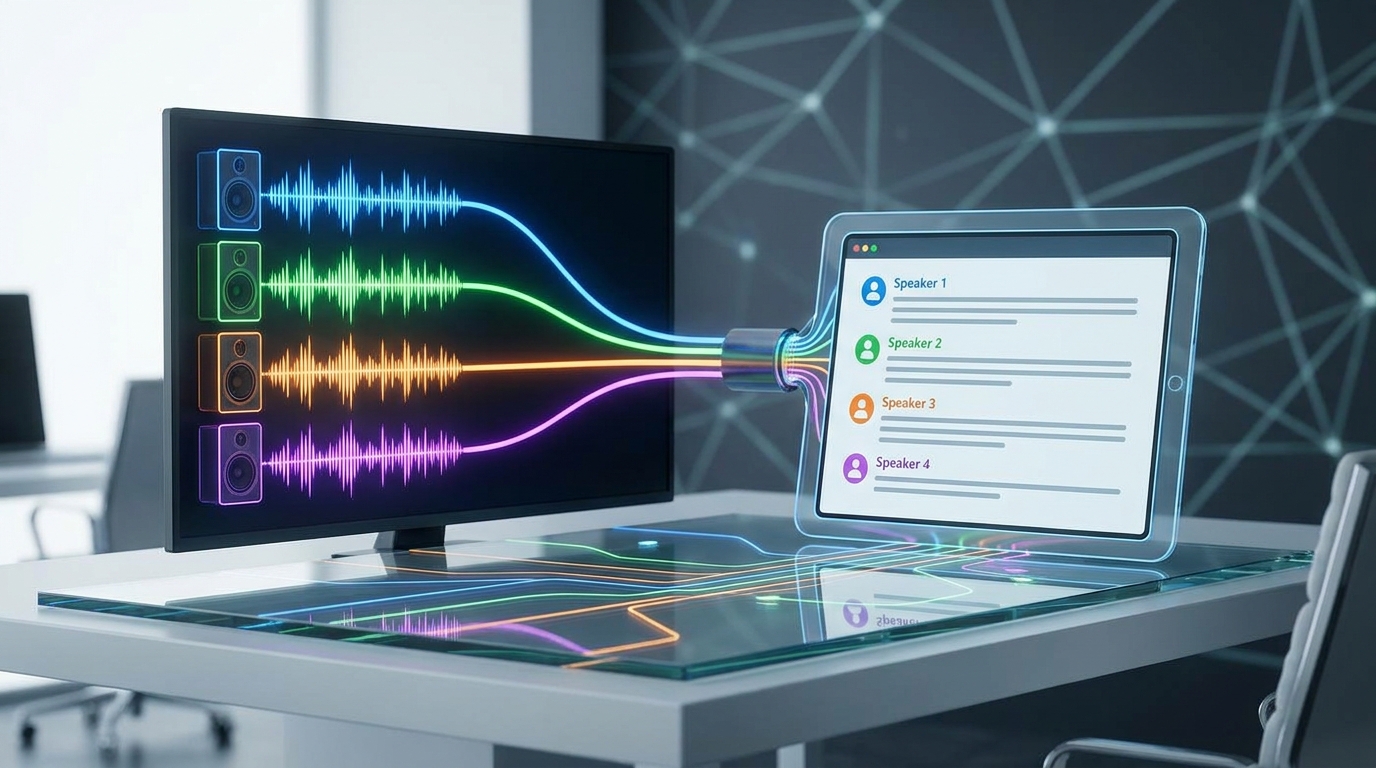
Visualizing the real-time flow from multi-speaker audio to diarized, labeled transcripts.
Why This Matters for Your Projects 🚀
For anyone building AI-powered voice applications, this is a game-changer. Imagine a virtual assistant that can not only understand your commands but also distinguish between you and your colleague in the same room. Or a meeting transcription service that automatically generates clean, speaker-separated notes without manual editing.
This technology enables a new generation of interactive AI. It means more robust and accurate real-time multi-speaker audio processing. You can create more sophisticated AI applications, from advanced transcription services and intelligent virtual assistants to enhanced meeting productivity tools. The quality and responsiveness of your AI-powered voice interactions will see a significant boost.
- Enhanced Meeting Productivity: Automatically generate meeting minutes that clearly attribute statements to individuals, making follow-ups and action items much easier. No more guessing who said what!
- Smarter Virtual Assistants: Build assistants that can handle multi-person interactions naturally, understanding context from different speakers in real-time.
- Improved Customer Service: Analyze live customer calls with speaker separation, allowing for better tracking of agent-customer interactions and sentiment.
- Interactive Learning Environments: Develop educational tools that can track contributions from multiple students in a live discussion.
Advertisement
Getting Started: Deployment & Requirements 💻
Ready to dive in? Deploying NVIDIA Nemotron 3 Diarization with Streaming Sortformer isn't overly complex, but it does have a few requirements. You'll be using NVIDIA Inference Microservices (NIMs), which are pre-built, optimized AI models ready for deployment. This simplifies the process for developers, letting you focus on your application rather than infrastructure.
You'll need NVIDIA's Riva SDK version 2.19.0 or higher. A Linux operating system is a must, and you'll need NVIDIA GPUs to power this real-time processing. NVIDIA recommends their H100, A100, or L40 GPUs for optimal performance, but other compatible GPUs may work. These are serious pieces of hardware, but they deliver the speed and accuracy you need for real-time AI. You can find more details and resources on the NVIDIA NGC Catalog.
Setting up your development environment for NVIDIA Nemotron 3 Diarization.
Potential Challenges and Considerations 🚧
While NVIDIA Nemotron 3 Diarization is incredibly powerful, it's good to be aware of a few things. The inherent transition latency, while small, means you won't get instantaneous speaker identification *at the very split second* someone starts talking. It needs a moment to 'listen' and confirm. This is usually fine for conversational AI but might be a consideration for extremely time-sensitive, sub-millisecond applications.
Also, while it supports up to four speakers, highly chaotic environments with many overlapping speakers might still pose a challenge for any diarization system. Always test with your specific use case and audio quality to understand its performance boundaries. Good quality audio input will always yield the best results!
💡 Pro Tip: For optimal real-time performance, ensure your audio input is as clean as possible, minimizing background noise and speaker overlap.
Key Takeaways
- NVIDIA's Streaming Sortformer model provides real-time speaker diarization, identifying and labeling speakers live.
- It integrates seamlessly with Nemotron ASR via the Riva SDK for live, diarized transcripts.
- The system supports up to 4 speakers simultaneously across 25 languages, with optimized English performance.
- Expect a few hundred milliseconds of transition latency after a speaker change for accurate labeling.
- Deployment requires Riva SDK 2.19.0+, Linux, and NVIDIA GPUs (H100, A100, L40 recommended).
Related on Tech4SSD 🔗
- Building Institutional Memory for AI Agents: How V7 Indexes Enterprise Context (2026)
- Custom AI Tools for Creative Workflows: Lessons from Google Flow (2026)
📩 Want the freshest AI trends every week?
Subscribe to Tech4SSD — practical AI tools and trends, explained for everyone. Free. Subscribe →
Advertisement
Frequently Asked Questions
What is the main difference between Nemotron ASR and Nemotron 3 Diarization?
Nemotron ASR focuses on converting speech to text (what was said). Nemotron 3 Diarization, specifically using the Streaming Sortformer model, adds the capability to identify *who* said what in real-time, assigning speaker labels to the transcribed text.
How many speakers can NVIDIA's real-time diarization handle?
The Streaming Sortformer model supports up to four speakers simultaneously in real-time. For scenarios with more speakers, you might need to consider offline processing or more advanced, non-real-time solutions.
Is Nemotron 3 Diarization available for all languages?
Yes, it works across all 25 languages supported by Nemotron ASR. While it's optimized for English, it provides multi-speaker identification capabilities for a wide range of global languages.
What hardware do I need to run this?
You'll need NVIDIA GPUs, with H100, A100, or L40 models being recommended for optimal performance. A Linux operating system and Riva SDK 2.19.0 or higher are also required.
Final Word
NVIDIA Nemotron 3 Diarization, powered by the Streaming Sortformer model and integrated with Nemotron ASR, is a significant leap forward for real-time multi-speaker audio processing. It empowers developers and creators like you to build more intelligent, responsive, and truly interactive AI applications. No longer will your AI be guessing who's talking; it will know, instantly.
This technology opens up a world of possibilities for automated assistants, enhanced meeting tools, and dynamic voice interfaces. So go ahead, experiment, build, and bring your AI projects to life with the power of real-time speaker identification! ✨
Sources & Further Reading
- NVIDIA Streaming Sortformer: Real-Time Speaker Diarization
- Automated Meeting Minutes with NVIDIA Nemotron Speech System
- Nemotron Speech Realtime Collection - NGC Catalog - NVIDIA
- Models — NVIDIA NeMo Framework User Guide
- NVIDIA Nemotron 3 ASR: 2026's Best Open-Source Live Speech
- Identify Speakers in Meetings, Calls, and Voice Apps in ...
- Which ASR models include built-in speaker diarization for multi-speaker recordings?
- Nemotron 3 ASR | NVIDIA NGC
- Nemotron Voice Agent Blueprint by NVIDIA
- Nemotron 3 ASR: 80ms Chunk, Lowest Latency 2026 Voice Applications
AI tools and features change fast — verify current options before relying on them. — Tech4SSD Editorial
Discussion
Have a question or something to add?
Join the discussion on Blogger