UN System Data Commons with Python: Ever wished you could tap into a massive, trusted reservoir of global statistics and make sense of it all with your coding skills? Good news! The UN System Data Commons with Python is making that dream a reality. This isn't just another data portal; it's a game-changer for anyone looking to build data-driven applications, conduct impactful research, or simply understand our world better.
In this article, we'll demystify how the UN System Data Commons works, especially with its powerful integration with Google's Data Commons and expanded API support. We'll show you how to leverage Python to query this treasure trove of AI-ready data, streamline your analysis workflows, and build truly innovative solutions. Get ready to feel like a data superhero! 🦸
Advertisement
What is the UN System Data Commons (and Why Should You Care)? 🤔
Imagine a single, reliable hub for all the United Nations' statistics, from climate change to education, health, and economic development. That's exactly what the UN System Data Commons (data.un.org) is becoming. It's a shared platform designed to bring together public data and statistics from across the entire UN system, making it easier than ever to access crucial global information.
But here's the kicker: it's not just about collecting data. The UN Data platform is evolving from a traditional data warehouse into an AI-ready knowledge graph. This means the data isn't just sitting there; it's being structured and harmonized so that AI tools can understand and use it more effectively. Think of it as giving your AI models a common language to speak when analyzing global trends. A public launch of expanded datasets is scheduled for September, so get ready!
Google's Role: Unifying Public and Private Data 🤝
This is where things get really exciting for developers and data enthusiasts. Google has stepped into the picture with its Data Commons on Spanner Graph, now generally available. What does this mean for you? It means you can now unify your own private knowledge graphs with vast public datasets, including those from the United Nations, all within Google's powerful cloud infrastructure. This isn't just about accessing data; it's about making it work seamlessly with your existing projects.
The Data Commons Platform from Google unifies public datasets from over 100 providers, including the UN. This integration enhances your data analysis workflows, allowing you to pull in global statistics alongside your proprietary data for richer insights. It's like having a super-powered data assistant that connects all the dots for you.
The Power of APIs: Connecting Your Code to Global Data 🔌
For us builders, APIs (Application Programming Interfaces) are our best friends. The UN System Data Commons aims to provide direct interfaces for researchers, developers, and organizations to connect UN system data to their own applications and analytical tools. This means you won't just be downloading static files; you'll be able to programmatically request and receive the data you need, when you need it.
And yes, these APIs will support common programming languages like Python! This is crucial because Python is a go-to for data analysis, machine learning, and automation. Imagine writing a few lines of Python code to fetch the latest SDG indicators directly into your Jupyter notebook or custom application. That's the kind of efficiency we're talking about. The platform also supports the SDMX technical standard version 3.0, offering out-of-the-box integration with popular tools like Tableau, Flourish, and Observable via SDMX-JSON and SDMX-CSV 2.0 formats.

Visualize the interconnectedness: Knowledge graphs are making complex global data more accessible and AI-ready.
Getting Started with Python and the UN Data API 🐍
While specific Python libraries for the new UN System Data Commons API are still emerging with its public launch, we can anticipate a workflow similar to other robust data APIs. Your journey will likely involve using popular Python libraries like requests for making API calls, pandas for data manipulation, and matplotlib or seaborn for visualization.
The goal is to provide easy access, so expect clear documentation and examples. You'll typically send a request to a specific API endpoint, perhaps filtering by country, indicator, or year, and receive data back in a structured format like JSON or CSV. From there, Python's ecosystem allows you to clean, transform, analyze, and visualize that data to extract meaningful insights.
- API Endpoint Discovery: Locate the specific API endpoints for the data you need on data.un.org. This is where you'll find the 'address' for your data requests.
- Authentication (if required): Some APIs require an API key or token for access. Ensure you have yours ready and understand how to include it in your requests.
- Python 'requests' library: Use this library to send HTTP requests (GET, POST) to the API. You'll specify parameters like indicators, countries, and time periods.
- Data Parsing: Once you receive the data (often in JSON), use Python's built-in
jsonlibrary orpandas.read_json()to parse it into a usable format, like a DataFrame. - Analysis and Visualization: Leverage
pandasfor cleaning and transformation, thenmatplotlib,seaborn, or even Google's Conversational Analytics API for rich visualizations and deeper analysis.
Advertisement
Example Workflow: Fetching SDG Data with Python (Conceptual) 📊
Let's imagine a scenario where you want to analyze Sustainable Development Goal (SDG) data for a specific region. With the UN System Data Commons API, your Python workflow might look something like this. (Note: This is a conceptual example, as the exact API structure will be detailed upon public launch.)
You'd start by importing your necessary libraries. Then, you'd construct your API request URL, including parameters for the SDG indicator you're interested in, the geographic area, and the time range. After making the request, you'd parse the JSON response into a pandas DataFrame. From there, the sky's the limit for your analysis – perhaps calculating trends, comparing regions, or feeding the data into an AI model for forecasting.
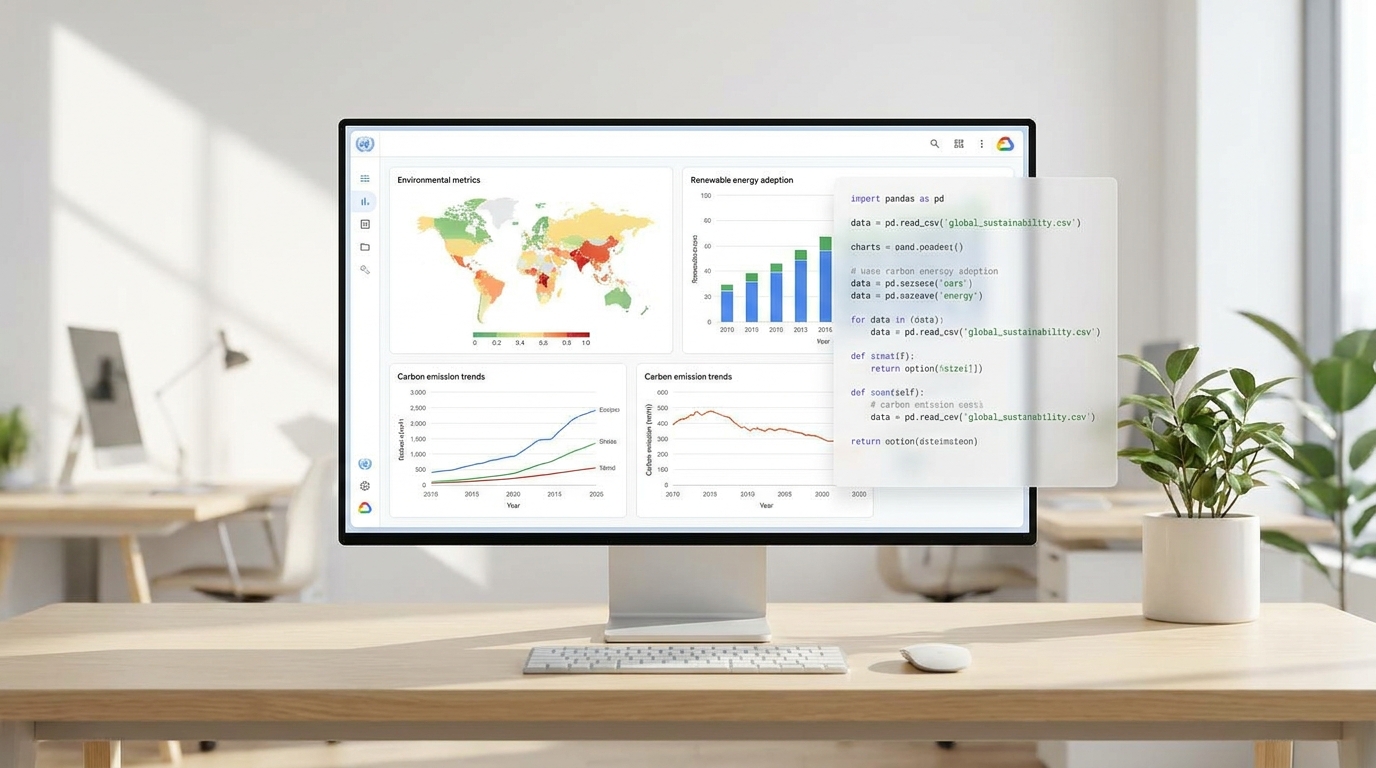
From raw data to actionable insights: Python empowers you to build powerful dashboards and analytical tools.
Why This Matters for Your Projects and AI Models 🚀
For creators, students, and small business owners, these developments are huge. They mean significantly easier and more unified access to a vast array of high-quality, harmonized public data. No more sifting through countless disparate sources! The AI-ready nature of the UN Data platform, combined with Google's integration capabilities, means your AI models can be trained on more consistent and comprehensive global statistics.
This opens doors for more sophisticated data analysis, better-informed decision-making, and the creation of innovative applications. Whether you're building a tool to track global health trends, developing an AI for social impact, or simply enriching your own research, the UN System Data Commons with Python provides a robust foundation. It's about empowering you to build better, faster, and with more reliable data at your fingertips.
Looking Ahead: The Future of Global Data Access 🌐
The convergence of the UN System Data Commons and Google's Data Commons on Spanner Graph is a powerful step towards democratizing access to global information. It's a testament to the idea that open, well-structured data can drive innovation and help us tackle some of the world's most pressing challenges. The focus on knowledge graphs and interoperability ensures that this data isn't just available, but truly usable by modern AI and analytical tools.
As the platform expands and more datasets become available, expect to see a surge in creative applications and research leveraging this resource. Keep an eye on data.un.org for the official public launch and detailed API documentation. Your next big project might just be powered by global statistics!
💡 Pro Tip: When working with large datasets from APIs, always implement pagination and error handling in your Python scripts to ensure robust and efficient data retrieval.
Key Takeaways
- The UN System Data Commons is becoming an AI-ready knowledge graph, providing a unified source of trusted UN statistics.
- Google's Data Commons on Spanner Graph allows you to integrate UN data with your private knowledge graphs for enhanced analysis.
- APIs supporting Python will enable programmatic access to UN data, streamlining data analysis workflows for developers.
- The platform's use of SDMX 3.0 standard ensures compatibility with popular data visualization tools like Tableau and Flourish.
- This initiative significantly lowers the barrier to entry for leveraging global public data in AI models and applications.
Related on Tech4SSD 🔗
- Google AI for Societal Impact: Practical Tools for Developers (2026)
- AI Tools Accelerating Scientific Research Workflows (2026)
- Google DevFest 2026: Practical Tools and Workflows for Building Agentic AI
📩 Want the freshest AI trends every week?
Subscribe to Tech4SSD — practical AI tools and trends, explained for everyone. Free. Subscribe →
Advertisement
Frequently Asked Questions
What is a knowledge graph and why is it important for UN data?
A knowledge graph structures data in a way that shows relationships between different pieces of information, much like how our brains connect ideas. For UN data, this means indicators, countries, and time periods are linked, making the data more understandable and 'AI-ready' for machine learning models to process and derive insights from.
Will I need a Google Cloud account to access the UN System Data Commons with Python?
While the UN System Data Commons (data.un.org) will offer its own APIs, integrating with Google's Data Commons on Spanner Graph for advanced features or combining with private datasets would likely benefit from or require a Google Cloud account. The UN's direct APIs should be accessible independently.
What kind of data can I expect to find in the UN System Data Commons?
You can expect a vast array of official statistics from across the UN system. This includes data related to Sustainable Development Goals (SDGs), economic indicators, social trends, environmental statistics, health data, education, and much more, all harmonized for consistency.
Is the UN System Data Commons API free to use?
The UN's commitment to open data suggests that core API access for public datasets will be free. However, specific usage limits, advanced features, or integrations with commercial platforms like Google Cloud might have associated costs or tiers. Always check the official documentation for the most up-to-date information.
Final Word
The future of data-driven insights is here, and it's more accessible than ever. The UN System Data Commons, powered by AI-ready knowledge graphs and integrated with platforms like Google's Data Commons, is setting a new standard for how we interact with global statistics. This isn't just about big organizations; it's about empowering every creator, student, and small business owner to make a difference with data.
So, roll up your sleeves, fire up your Python editor, and get ready to explore a world of data that can inform your projects, fuel your innovations, and help you understand the complex tapestry of our planet. The power to analyze global trends and build impactful solutions is now truly at your fingertips! ✨
Sources & Further Reading
- New UN system platform puts millions of data points at users’ fingertips, says Guterres | UN News
- UN Data: Your AI-ready gateway to curated and trusted UN System data | United Nations
- Unify public and private data with Data Commons on Spanner Graph | Google Cloud Blog
- Table of Contents
- UN System Data Commons
- Briefing on the United Nations System Data Commons | UN Web TV
- [PDF] AI-Ready Official Statistics: Opportunities, Challenges, and ...
- Connecting SDGs-related Information Resources with Linked Data
- Python UDF in BigQuery, now generally available | Google Cloud Blog
- Build data agents with Conversational Analytics API | Google Cloud Blog
- Which APIs are available and where can I find information about them? | data.europa.eu
- Exploring regional similarities with EU Twinnings | data.europa.eu
- About SPARQL | data.europa.eu
- The European Single Access Point on data.europa.eu: Harvesting guidelines
AI tools and features change fast — verify current options before relying on them. — Tech4SSD Editorial


Discussion
Have a question or something to add?
Join the discussion on Blogger