AI tools accelerating scientific research: Ever wondered how science is making leaps and bounds faster than ever before? It’s not magic, it’s AI tools accelerating scientific research! 🚀 Modern artificial intelligence isn't just for chatbots; it's becoming the ultimate lab partner, helping scientists unlock mysteries and speed up discoveries across fields like medicine, genomics, and materials science.
In this article, we'll demystify how cutting-edge AI, from multi-agent systems to specialized models, is transforming the scientific workflow. You'll learn about specific tools and frameworks that are making a real impact, and why this matters for anyone interested in building the future. Ready to see how AI is changing the game for good?
Advertisement
The Rise of AI Agents in the Lab 🤖
Imagine having a virtual colleague who can brainstorm new ideas, design experiments, and even analyze complex data – all with lightning speed. That's the power of agentic AI frameworks. These aren't just single AI models; they're systems of interconnected AI agents that work together, much like a team of human researchers, but without coffee breaks! They're designed to tackle complex scientific problems by breaking them down and assigning tasks to specialized AI components.
This multi-agent approach is a game-changer because it allows for more sophisticated problem-solving than individual models could achieve. By automating repetitive or computationally intensive tasks, these agents free up human scientists to focus on higher-level thinking, interpretation, and strategic direction. It’s about augmenting human ingenuity, not replacing it.
Co-Scientist: Your Virtual Research Partner 🔬
One of the most exciting developments in this space is Google's Co-Scientist. Built on the powerful Gemini models, Co-Scientist is a multi-agent AI system designed to act as a virtual scientific collaborator. Think of it as an AI team member that can generate novel research hypotheses, propose experimental designs, and even help interpret results.
Co-Scientist doesn't just crunch numbers; it aims to understand the nuances of scientific inquiry. This means it can help researchers explore avenues they might not have considered, leading to truly innovative breakthroughs. It’s like having an expert consultant available 24/7, ready to push the boundaries of what's possible in your research.
- Hypothesis Generation Co-Scientist can sift through vast amounts of existing literature and data to propose new, testable hypotheses.
- Experimental Design It assists in structuring experiments, suggesting optimal parameters and controls to ensure robust results.
- Data Interpretation The system can help make sense of complex datasets, identifying patterns and insights that might be missed by human observation alone.
Unlocking the Genome with AlphaGenome 🧬
Genomics, the study of our complete set of DNA, is a field ripe for AI acceleration. Enter AlphaGenome, a deep learning model from Google DeepMind. This specialized model is designed to decipher the functional regulatory code of the human genome. What does that mean for you?
It means AlphaGenome can analyze large-scale DNA sequences with incredible precision, down to a single base. Understanding this 'code' is crucial for everything from identifying genetic predispositions to diseases to developing personalized medicine. By providing such detailed insights, AlphaGenome significantly speeds up the foundational research needed for medical advancements.
BioNeMo: The Drug Discovery Powerhouse 💊
Drug discovery is notoriously slow and expensive. But NVIDIA's BioNeMo is changing that. This isn't just one model; it's an open-source collection of models and a scalable training system for biomolecular AI. BioNeMo offers GPU-accelerated performance, providing researchers with comprehensive resources for everything from protein folding to molecular generation.
Think of BioNeMo as a complete toolkit for AI-driven drug discovery. It includes powerful models like AlphaFold2 for predicting protein structures, DiffDock 2.0 for molecular docking, RFdiffusion for protein design, MolMIM for molecular optimization, and ProteinMPNN for protein sequence design. This comprehensive suite significantly shortens the time from initial concept to potential drug candidate, which could lead to life-saving treatments reaching patients faster.
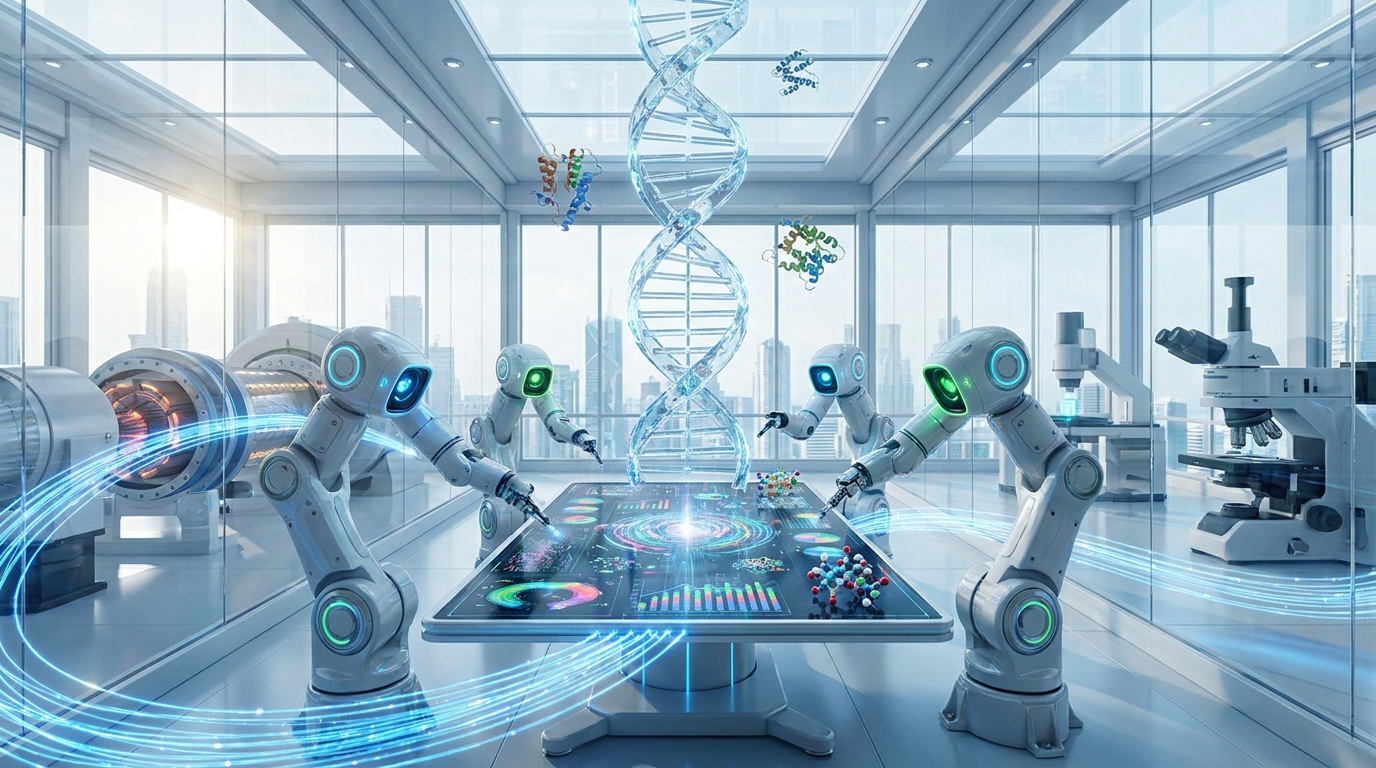
AI agents like those in BioNeMo are accelerating drug discovery by tackling complex biomolecular problems.
Advertisement
MedGemma: AI for Medical Insights 🩺
In the medical field, clear and accurate information is paramount. MedGemma, built on Google's Gemma 3 models, brings powerful AI to medical text and image comprehension. These open models come in various sizes (4B multimodal, 27B text-only, and 27B multimodal), making them adaptable for different tasks.
MedGemma's applications are vast. It can assist with interpreting medical images, helping doctors spot anomalies more quickly and accurately. It also aids in clinical reasoning, providing support for diagnosis and treatment planning by processing vast amounts of medical literature. This means better, faster medical insights, ultimately improving patient care.
Building Your Own Scientific Agents with ADK 🛠️
The best part? You don't have to be a giant tech company to leverage these advancements. The Agent Development Kit (ADK) and Gemini models empower developers and researchers to build their own specialized agents. A fantastic example is the Proteomics Lab Agent, developed with the Max Planck Institute of Biochemistry.
This open-source project, available on GitHub, simplifies complex scientific procedures, making advanced research more accessible. This democratization of AI agent building means that even smaller labs and individual researchers can create tailored AI tools to solve their unique scientific challenges. It's about putting powerful AI into your hands.

AI coding assistants streamline the translation of scientific hypotheses into executable code.
AI Coding Assistants: From Hypothesis to Code 💻
Once a hypothesis is formed, the next step is often to translate it into executable code for simulations, data analysis, or experimental control. This is where AI coding assistants like Gemini Code Assist and Gemini CLI shine. They accelerate this crucial step, automating script generation and streamlining workflow management directly from your command line.
Beyond coding, these assistants can even help generate publication-ready text and figures, significantly reducing the time spent on preparing research for dissemination. This means scientists can spend less time on tedious coding and formatting, and more time on the actual science, pushing their discoveries to the world faster.
- Faster Scripting Generate complex code snippets and scripts with natural language prompts, reducing manual coding time.
- Workflow Automation Automate repetitive tasks and manage entire research workflows directly from the command line.
- Publication Prep Draft scientific texts, summarize findings, and even generate data visualizations for reports and papers.
Key Takeaways
- AI agents and specialized models are profoundly accelerating scientific discovery, automating hypothesis generation, experimental design, and data analysis.
- Tools like Google's Co-Scientist act as virtual collaborators, generating novel research ideas and experimental proposals.
- Domain-specific models such as AlphaGenome (genomics) and MedGemma (medical insights) provide deep, precise analysis in critical fields.
- Open-source frameworks like NVIDIA BioNeMo and Google's ADK democratize access to powerful AI, enabling faster drug discovery and custom agent creation.
- AI coding assistants like Gemini Code Assist streamline the translation of scientific ideas into executable code and assist with publication preparation.
Related on Tech4SSD 🔗
- Google DevFest 2026: Practical Tools and Workflows for Building Agentic AI
- Integrating Autonomous AI Agents into Software Engineering (2026)
- Choosing Your AI Cloud Compute: Data, Inference, and Agent Workloads (2026)
📩 Want the freshest AI trends every week?
Subscribe to Tech4SSD — practical AI tools and trends, explained for everyone. Free. Subscribe →
Advertisement
Frequently Asked Questions
What is an AI agent in scientific research?
An AI agent in scientific research is an autonomous or semi-autonomous AI program designed to perform specific tasks, such as generating hypotheses, designing experiments, or analyzing data, often working collaboratively within a multi-agent system.
How do AI tools accelerate drug discovery?
AI tools accelerate drug discovery by automating and optimizing various stages, including identifying potential drug targets, predicting molecular interactions (e.g., protein folding, docking), designing novel compounds, and analyzing vast chemical libraries, significantly reducing the time and cost involved.
Are these AI tools only for large institutions?
Not at all! While large institutions certainly leverage these tools, the increasing availability of open-source models (like BioNeMo) and development kits (like Google's ADK) means that smaller labs, startups, and individual researchers can also build and deploy powerful AI solutions for their specific needs.
Final Word
The landscape of scientific research is undergoing a profound transformation, driven by the incredible capabilities of AI agents and specialized models. What once took years of painstaking effort can now be achieved in a fraction of the time, opening doors to discoveries that were previously unimaginable. From decoding our genome to designing life-saving drugs, AI is not just a tool; it's a catalyst for a healthier, more knowledgeable future.
As builders, developers, and curious minds, you now have access to an unprecedented arsenal of AI power. The opportunity to contribute to groundbreaking science, whether by developing new agents or applying existing models, is immense. So, dive in, experiment, and help shape the next era of scientific innovation! ✨
Sources & Further Reading
- Accelerate R&D with Co-Scientist and AlphaEvolve agents | Gemini Enterprise | Google Cloud Documentation
- Agentic AI framework in life sciences for R&D | Google Cloud Blog
- How scientists can use Gemini Enterprise for AI workflows
- AI experts: How the Planck Institute is sharing research skills through multimodal agents | Google Cloud Blog
- AlphaGenome | Gemini Enterprise Agent Platform | Google Cloud Documentation
- Accelerating AI in healthcare using NVIDIA BioNeMo Framework and Blueprints on GKE
- MedGemma | Health AI Developer Foundations | Google for Developers
- AlphaEvolve is available for everyone | Google Cloud Blog
- Build a deep research agent with Google ADK | Google Cloud Blog
- Escalante uses JAX on TPUs for AI-driven protein design | Google Cloud Blog
AI tools and features change fast — verify current options before relying on them. — Tech4SSD Editorial
Discussion
Have a question or something to add?
Join the discussion on Blogger