ReviewBench: Ever wonder how good those AI code review tools *really* are? You're not alone! It's tough to cut through the marketing hype and find out which AI agents genuinely improve your code. That's where ReviewBench steps in. It's an open-source framework designed to give you a clear, unbiased look at how these AI tools perform on real-world coding challenges. Think of it as your personal truth-teller in the wild west of AI development. 🤖
In this article, we'll break down exactly what ReviewBench is, how it works its magic using real GitHub Pull Requests, and why its unique 'LLM-as-judge' approach is a game-changer for evaluating AI. You'll learn how structured prompts can dramatically shift an agent's performance and why understanding these benchmarks is crucial for any creator, student, or small-business owner looking to leverage AI in their coding workflow. Let's demystify AI code review together!
Advertisement
What is ReviewBench and Why Does it Matter? 💡
ReviewBench is an open-source framework built to evaluate AI code review agents. In plain English? It's a transparent, repeatable way to test how well AI tools can spot issues and suggest improvements in your code. For anyone building software, from indie developers to small teams, knowing which AI can truly help is gold. This framework cuts through the noise, offering a clear picture of an AI's efficacy.
Why is this so important? Because not all AI code review agents are created equal, and their performance can vary wildly. ReviewBench gives you the power to understand these differences, helping you choose tools that genuinely enhance code quality and streamline your development process. It's all about making informed decisions, not just following the latest trend.
Real-World Data: The Heart of ReviewBench 💖
Unlike benchmarks that rely on synthetic or outdated data, ReviewBench anchors its evaluations in the messy, wonderful reality of software development: GitHub Pull Requests (PRs). This is crucial because real-world code reviews often involve complex context, subtle bugs, and human-like nuances that synthetic data can't replicate. By using actual PRs, ReviewBench ensures its findings are practically relevant.
The framework offers two key ways it gathers this real-world data. First, an 'offline' benchmark uses human-curated 'golden comments' on past PRs as the gold standard. Second, and perhaps most innovative, is the 'online' benchmark. This continuously samples *fresh* PRs and uses the developer's *actual fixes* after a review as the ground truth. This clever approach avoids data leakage and keeps the benchmark current, reflecting how developers truly interact with code changes.
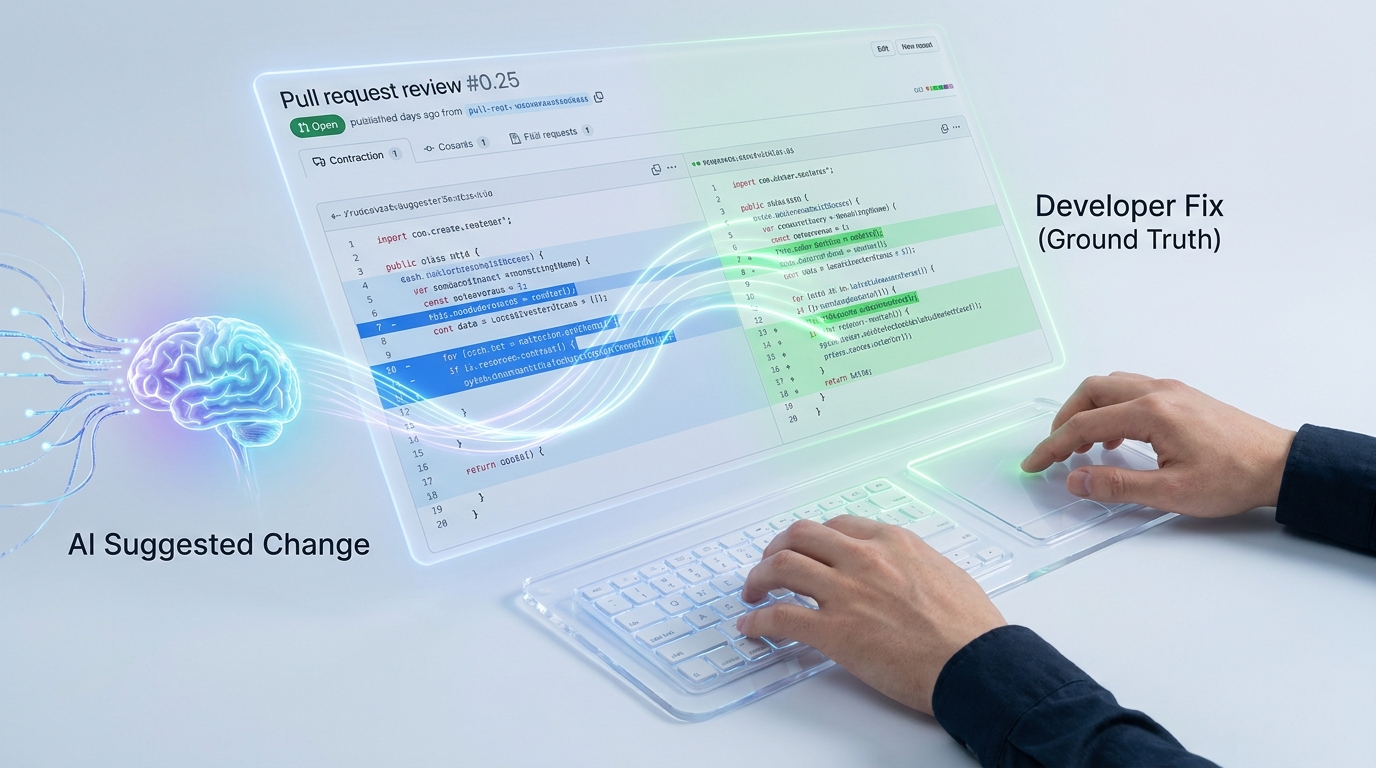
ReviewBench uses real GitHub PRs and developer fixes to ensure its AI evaluations are grounded in practical utility.
'LLM-as-Judge': The AI Evaluating AI ⚖️
Here's where it gets really interesting: ReviewBench doesn't just rely on simple pass/fail metrics. It uses an 'LLM-as-judge' methodology. This means another large language model (LLM) is brought in to act as a sophisticated evaluator. This LLM analyzes the AI agent's suggestions, compares them to the human developer's actions (the 'ground truth'), and determines how accurate and helpful the AI's comments were.
This approach allows for a much more nuanced assessment of AI performance. The LLM judge can understand context, identify subtle issues, and even gauge the *quality* of a suggestion, not just its presence. It's like having an expert human reviewer, but scalable and consistent. The results are even stored per judge model (e.g., Claude Sonnet 4.5, GPT-5.2) to account for potential variances in the judging LLM itself, ensuring transparency.
Precision, Recall, and What They Mean for You 🎯
When ReviewBench's LLM judge gets to work, it focuses on two key metrics: precision and recall. Don't let the jargon scare you; they're pretty straightforward once you break them down.
Precision tells you the percentage of the AI bot's comments that were actually useful and correct. Think of it as how often the AI is *right* when it speaks up. High precision means fewer irrelevant or misleading suggestions. Recall, on the other hand, measures the percentage of *real issues* in the code that the AI bot successfully caught. This tells you how comprehensive the AI's review was – did it miss anything important? A high recall means the AI is good at finding most problems. Together, these metrics give a balanced view of an AI agent's effectiveness.
- Precision: How many of the AI's suggestions were actually helpful and correct? (Less noise, more signal!)
- Recall: How many of the actual problems in the code did the AI successfully identify? (Did it catch the important stuff?)
Advertisement
The Power of Prompt Engineering ✍️
One of the most eye-opening findings from ReviewBench is just how much structured review prompts impact an AI agent's performance. You might think an AI just 'knows' what to do, but how you ask it to perform a review makes a monumental difference. Crafting a clear, detailed prompt can unlock an AI's true potential, guiding it to focus on specific aspects of code quality, security, or best practices.
For example, ReviewBench showed that a new, carefully structured review prompt dramatically improved an agent named Luna's score to 0.32 on a specific task slice. This allowed Luna to outperform other agents like Kimi K3 (0.25) and Opus 4.8 (0.23), which were using more static, less optimized prompts. This highlights that it's not just about the AI model itself, but how skillfully you direct it. This is a huge win for prompt engineers and developers looking to get the most out of their AI tools.

Well-crafted prompts are essential for guiding AI code review agents to deliver their best results.
Who's Being Benchmarked? The AI Lineup 🤖
ReviewBench isn't just a theoretical exercise; it's actively tracking and evaluating a wide array of popular AI code review agents. This gives you a direct comparison of tools you might already be using or considering. Knowing how these agents stack up against each other on real-world metrics is invaluable for making smart choices for your projects.
The lineup of bots tracked by ReviewBench includes some familiar names and some emerging players. This continuous evaluation means the benchmark stays relevant as the AI landscape evolves. You can check out the latest results directly on the ReviewBench GitHub repository to see how your favorite tools are performing. For instance, you can explore the withmartian/code-review-benchmark for detailed methodology and current standings.
- Current Agents Tracked: CodeRabbit, GitHub Copilot, Claude, Cursor, Augment, Codex, Gemini, Greptile, Graphite, Qodo, and Propel.
Benchmarking Your Own AI Workflows 🛠️
One of the most exciting aspects of ReviewBench for builders and developers is its open-source nature. This isn't just a tool for big companies; it's a framework you can use to benchmark your *own* custom code-review LLM workflows. Have you fine-tuned an LLM for a specific coding style or language? Are you experimenting with unique prompt engineering strategies?
ReviewBench provides the datasets, the LLM judge components, and the pipeline code you need to integrate your own agents and evaluate them against real-world standards. This empowers you to iterate, improve, and confidently deploy AI solutions tailored to your exact needs. It's a fantastic resource for anyone looking to push the boundaries of AI-assisted development, whether you're a student working on a project or a small business owner optimizing your team's efficiency.
💡 Pro Tip: When evaluating AI code review agents, always consider both precision (how often it's right) and recall (how many issues it catches) to get a balanced view of its effectiveness.
Key Takeaways
- ReviewBench is an open-source framework for evaluating AI code review agents using real-world GitHub Pull Requests.
- It uses an 'LLM-as-judge' approach to assess performance, with precision and recall as key metrics.
- The framework's 'online' benchmark continuously samples fresh PRs, using developer fixes as ground truth to avoid data leakage.
- Structured review prompts significantly impact AI agent performance, often more than the base model itself.
- ReviewBench allows developers to benchmark their own custom AI code review workflows, fostering innovation and transparency.
Related on Tech4SSD 🔗
- Building Custom Workflows in GitHub Copilot Workspace Using Canvases (2026)
- Open-Sourcing AstaBrief: Fast AI Report Generation for Developer Workflows (2026)
📩 Want the freshest AI trends every week?
Subscribe to Tech4SSD — practical AI tools and trends, explained for everyone. Free. Subscribe →
Advertisement
Frequently Asked Questions
Is ReviewBench only for large companies?
Absolutely not! ReviewBench is open-source and designed for anyone – from individual developers and students to small business owners – to evaluate AI code review agents or even benchmark their own custom AI workflows.
What does 'LLM-as-judge' mean?
It means another advanced AI (a Large Language Model) is used to evaluate the performance of the AI code review agent. This judge LLM assesses the quality and relevance of the agent's suggestions by comparing them to real human developer actions.
How does ReviewBench prevent data leakage?
ReviewBench's 'online' benchmark continuously samples *fresh* GitHub Pull Requests. It then uses the *developer's actual fixes* after the review as the ground truth, ensuring the AI isn't being tested on data it might have already seen during training.
Can I contribute my own AI agent to ReviewBench?
Yes! ReviewBench is an open-source framework. It provides the necessary datasets, LLM judge components, and pipeline code, making it possible for you to integrate and evaluate your own custom AI code review agents.
Final Word
ReviewBench is more than just another benchmark; it's a vital step towards transparency and practical utility in the world of AI code review. By focusing on real-world GitHub PRs and employing a sophisticated 'LLM-as-judge' methodology, it provides insights that are genuinely useful for anyone looking to integrate AI into their development workflow. Understanding how different LLM judges and, crucially, how *prompt engineering* influences results empowers you to make smarter choices and build better AI solutions.
So, whether you're a developer choosing your next AI assistant or a creator experimenting with AI to streamline your coding, ReviewBench offers a clear path to understanding what truly works. Dive in, experiment, and let this powerful framework guide you to more efficient, higher-quality code. Your future self (and your codebase) will thank you! ✨
Sources & Further Reading
- withmartian/code-review-benchmark
- sonar-review-bench/code-review-benchmark
- works/langchain-reviewbench-translation.md
- code-review-benchmark/methodology/full.md at main
- ReviewBench: An Extensible Framework for Benchmarking ...
- ZZR0/SWRench
- FoundryHQ-AI/swe-prbench
- shim52/ai-code-review-bench: How good is ...
- c-CRAB-Benchmark/dataset
- YuYuCodeNoob/opencode-bench
AI tools and features change fast — verify current options before relying on them. — Tech4SSD Editorial
Discussion
Have a question or something to add?
Join the discussion on Blogger