Hugging Face Open TTS Leaderboard: Ever wondered how those incredibly realistic AI voices are truly measured? 🤔 The Hugging Face Open TTS Leaderboard is your go-to hub for understanding the cutting edge of text-to-speech (TTS) and voice cloning. It’s where the best models, both open-source and proprietary, battle it out to see who can create the most natural, expressive, and multilingual AI voices.
This isn't just about cool tech; it's about practical tools for creators, students, and small business owners like you. We’ll break down what makes a voice model truly great, how new evaluation methods are changing the game, and which top performers are leading the pack. Get ready to feel empowered to choose the right AI audio tools for your projects! ✨
Advertisement
What is the Hugging Face Open TTS Leaderboard? 📊
Think of the Hugging Face Open TTS Leaderboard as the ultimate scorecard for AI voices. It's a dynamic platform where cutting-edge text-to-speech and voice cloning models are rigorously tested and ranked. This isn't just a popularity contest; it’s a scientific evaluation designed to help developers and users understand the true capabilities of different AI audio solutions.
The leaderboard covers everything from zero-shot TTS (where a model generates a voice it's never heard before) to multilingual capabilities. It’s constantly evolving, introducing new metrics and benchmarks to keep pace with the rapid advancements in AI voice technology. For anyone looking to integrate AI voices into their projects, this leaderboard is an invaluable resource for making informed decisions.
Beyond Simple Scores: New Evaluation Metrics Emerge 🔬
Gone are the days when simple metrics like Word Error Rate (WER) or Speaker Identification Metric (SIM) were enough. While still useful, the new generation of TTS models demands more sophisticated evaluation. The Hugging Face Open TTS Leaderboard is now pushing for comprehensive metrics that capture the nuances of human perception and real-world application.
One major advancement is the Seed-TTS-eval protocol. This isn't just about accuracy; it's about robustness. It includes controlled length distributions and phonetic coverage, ensuring models are tested under diverse and challenging conditions. Plus, they're setting human toplines across various metrics in six different language variants, giving us a true benchmark for naturalness.
This shift means you can trust the rankings more. It’s not just about a model sounding 'okay'; it’s about how well it performs across different languages, accents, and speaking styles, just like a real human voice would.
Crowdsourced Wisdom: Human Perception Takes Center Stage 🗣️
What sounds natural to a machine might not sound natural to a human ear. That's why the leaderboard is embracing crowdsourced pairwise evaluation, especially for multilingual TTS. This involves real people listening to and comparing different AI voices, providing feedback that goes beyond automated scores. It’s a game-changer for understanding true voice quality.
This evaluation incorporates linguistic control and perceptually grounded annotation across 10 Indic languages. Listeners judge voices across six crucial perceptual dimensions:
This human-centric approach ensures that the top-ranked models don't just perform well on technical metrics, but also genuinely resonate with listeners, making them more suitable for real-world applications where naturalness is key.
- Intelligibility: Can you clearly understand what's being said?
- Expressiveness: Does the voice convey appropriate emotion and tone?
- Voice Quality: Is the sound clear, pleasant, and free from artifacts?
- Liveliness: Does the voice sound natural and engaging, not robotic?
- Noise: Are there any unwanted background sounds or distortions?
- Hallucinations: Does the model add sounds or words that weren't in the original text?
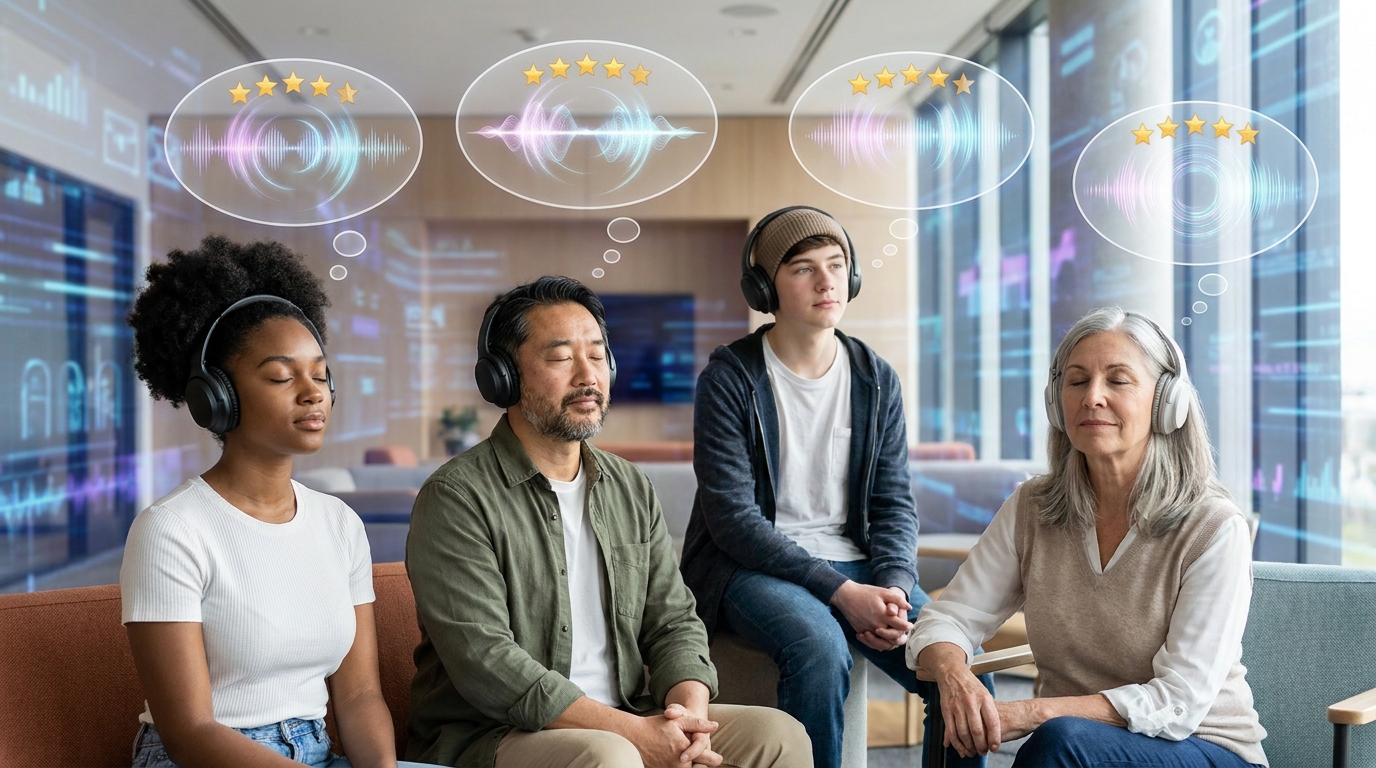
Human listeners are crucial for evaluating the naturalness and quality of AI voices.
Who's Leading the Pack? Top Performers Revealed 🏆
So, who's making waves on the Hugging Face Open TTS Leaderboard? In multilingual evaluations, the big names you'll see consistently at the top are proprietary powerhouses like Gemini 2.5 Pro TTS and Eleven Labs v3, alongside Sonic 3. These models are pushing the boundaries of what's possible in generating highly natural and diverse voices across many languages.
But don't count out open-source contenders! For those who prefer more control and transparency, models like Raon-OpenTTS-1B are showing incredible promise. It ranks second on WER (Word Error Rate) and first on SIM (Speaker Identification Metric) among open-weight TTS baselines. This means you can get top-tier performance without being locked into a proprietary system.
And for speed demons, Qwen3-TTS-GGUF has achieved the fastest time-to-first-audio (TTFA) on the leaderboard's streaming benchmark as of September 9, 2026. This is huge for applications where instant audio generation is critical, like real-time communication or interactive experiences.
Advertisement
Open-Source vs. Proprietary: What's Best for You? 🤔
The Hugging Face Open TTS Leaderboard showcases both open-source and proprietary models, and understanding the differences is key to choosing the right tool for your project. Proprietary models, like Gemini 2.5 Pro TTS or Eleven Labs v3, often offer highly polished, ready-to-use solutions with extensive support and advanced features. They might come with a cost, but they deliver exceptional quality and ease of integration.
On the other hand, open-source models like Raon-OpenTTS-1B provide flexibility, transparency, and often a lower barrier to entry. You can inspect their code, customize them to your specific needs, and contribute to their development. While they might require a bit more technical know-how to set up, they empower you with full control over your AI voice generation.
Your choice depends on your priorities: do you value out-of-the-box excellence and convenience (proprietary), or flexibility, cost-effectiveness, and community-driven development (open-source)? The leaderboard helps you compare their performance directly, making your decision much easier.

Choosing between open-source and proprietary depends on your project's needs for flexibility versus convenience.
Why These Benchmarks Matter for Creators & Businesses 🚀
For creators, students, and small business owners, these advancements in the Hugging Face Open TTS Leaderboard are a big deal. They mean you have more reliable and nuanced ways to evaluate and select the perfect TTS or voice cloning model for your needs. Whether you're creating audiobooks, developing accessible interfaces, or generating marketing voiceovers, knowing which models truly excel in naturalness and multilingual support is invaluable.
The focus on human-centric evaluation and diverse language coverage isn't just academic; it directly translates to more natural and versatile AI voices for your projects. This drives innovation, ensuring that the AI voices you use are not only technically sound but also emotionally engaging and culturally appropriate.
Ultimately, stronger open-source contenders alongside proprietary solutions foster healthy competition. This pushes everyone to innovate, leading to better, more accessible, and more affordable AI voice technologies for everyone. It means you'll have more powerful tools at your fingertips to bring your ideas to life.
💡 Pro Tip: When selecting a TTS model, don't just look at raw scores. Consider the specific languages you need, the desired emotional range, and whether you need real-time generation. The Hugging Face Open TTS Leaderboard provides these granular insights!
Key Takeaways
- The Hugging Face Open TTS Leaderboard is the definitive platform for benchmarking multilingual text-to-speech and voice cloning models.
- New evaluation metrics, like the Seed-TTS-eval protocol and crowdsourced human perception, are providing a more accurate assessment of AI voice quality and naturalness.
- Top performers include proprietary models like Gemini 2.5 Pro TTS and Eleven Labs v3, but open-source options like Raon-OpenTTS-1B are showing strong competitive performance.
- The leaderboard helps users choose between proprietary solutions (polished, ready-to-use) and open-source models (flexible, customizable) based on their project needs.
- These advancements mean more reliable, versatile, and natural AI voices for creators, students, and small businesses globally.
Related on Tech4SSD 🔗
📩 Want the freshest AI trends every week?
Subscribe to Tech4SSD — practical AI tools and trends, explained for everyone. Free. Subscribe →
Advertisement
Frequently Asked Questions
What is 'zero-shot TTS'?
Zero-shot TTS refers to a text-to-speech model's ability to generate speech in a voice it has never explicitly been trained on, often by simply providing a short audio sample of the desired voice. It's like teaching a model to mimic a new voice on the fly!
How does the Hugging Face Open TTS Leaderboard measure 'multilingual' performance?
The leaderboard uses advanced protocols like Seed-TTS-eval and crowdsourced evaluations across multiple language variants (e.g., en-US, es-ES, 10 Indic languages) to assess how well models perform in diverse linguistic contexts, including intelligibility, expressiveness, and voice quality in each language.
Why is 'Time-to-First-Audio' (TTFA) important for TTS models?
TTFA measures how quickly a model can start generating audio after receiving a text input. This is crucial for real-time applications like live voice assistants, interactive games, or instant content generation, where delays can significantly impact user experience.
Final Word
The world of AI voices is evolving at lightning speed, and the Hugging Face Open TTS Leaderboard is your compass through this exciting landscape. By focusing on robust, human-centric, and multilingual evaluation, it’s not just ranking models; it’s shaping the future of how we interact with AI. You now have a clearer picture of what makes a great AI voice and where to find it.
So, whether you're building the next great podcast, making educational content more accessible, or simply experimenting with AI, the insights from this leaderboard empower you to choose tools that truly deliver. Dive in, explore the possibilities, and let your creativity speak volumes! 🎤
Sources & Further Reading
- Open TTS Leaderboard - a Hugging Face Space by hf-audio
- nineninesix/multilingual-speech-benchmark · Datasets at Hugging Face
- Paper page - Preferences of a Voice-First Nation: Large-Scale Pairwise Evaluation and Preference Analysis for TTS in Indian Languages
- TTS Arena: Benchmarking Text-to-Speech Models in the Wild
- Paper page - Raon-OpenTTS: Open Models and Data for Robust Text-to-Speech
- Serveurperso/Qwen3-TTS-GGUF · Hugging Face
- KRAFTON/Raon-OpenTTS-1B · Hugging Face
- KRAFTON/Raon-OpenTTS-0.3B · Hugging Face
- gijs/openechotts-50k · Hugging Face
- The SpeechLLM Playbook
AI tools and features change fast — verify current options before relying on them. — Tech4SSD Editorial


Discussion
Have a question or something to add?
Join the discussion on Blogger