prompt caching: Ever felt like your AI applications are burning through tokens faster than you can say "large language model"? You're not alone! 💸 Optimizing prompt caching is your secret weapon to dramatically reduce those pesky LLM API costs and boost performance. It's not just about saving money; it's about making your AI tools faster, smarter, and more practical for everyday use.
OpenAI's latest GPT-6 Sol and Luna models are shaking things up with some seriously powerful new caching features. We're talking granular control, insightful diagnostics, and big-time savings. This guide will demystify these advancements, showing you how to leverage them to build more efficient and responsive AI applications. Ready to become a caching wizard? Let's dive in! ✨
Advertisement
Why Prompt Caching is Your New Best Friend 🤝
Think of prompt caching like your browser remembering frequently visited websites. Instead of fetching everything from scratch every single time, it stores common parts of your prompt. For LLMs, this means if you're sending the same initial instructions or a long conversation history repeatedly, the model doesn't have to re-process those tokens. It just pulls them from the cache, saving you time and, more importantly, money.
Before GPT-6, caching was often a 'black box' feature – helpful, but hard to control. Now, with the Sol and Luna models, OpenAI has pulled back the curtain, giving developers unprecedented tools to manage and optimize this powerful feature. This is a game-changer for anyone building agentic AI, chatbots, or applications with long, persistent contexts. It means your AI can remember more without costing a fortune.
GPT-6's Game-Changing Cost Savings 💰
Let's talk numbers, because that's where the real magic happens. GPT-6 Sol and Luna models aren't just incrementally better; they offer significant financial advantages. You're looking at a whopping 90% discount on cached input-token reads. Yes, you read that right – 90%! This means if a part of your prompt is cached, you pay a tiny fraction of the cost you would for fresh processing.
On top of that, OpenAI has reduced API prices for GPT-6 by 50% compared to the GPT-5.6 promotional pricing. Combine these two factors, and you're looking at a massive reduction in your operational costs for LLM applications. This isn't just for big tech companies; it makes advanced AI much more accessible and sustainable for small businesses and individual creators. Imagine the projects you can now afford to build!
Pinpoint Control with Explicit Breakpoints 🎯
One of the most exciting new features is the introduction of explicit breakpoint functionality. This is where you, the developer, get to tell the AI exactly where to stop caching. Why is this a big deal? Imagine you have a long system prompt or a conversation history that rarely changes, but the user's latest query is always unique.
With breakpoints, you can mark the end of the static part of your prompt. Everything *before* the breakpoint gets cached and reused, saving you money. Everything *after* it, like the dynamic user input, is processed fresh. This ensures you're only paying for what truly needs new computation, optimizing for content reuse and avoiding charges for frequently changing content. It's like having a smart filter for your tokens!

Explicit breakpoints allow you to define exactly which parts of your prompt get cached, saving you tokens and dollars.
Unmasking Cache Performance with Diagnostics 🔍
No more guessing games! OpenAI has rolled out powerful prompt cache diagnostics for GPT-5.6 and later models. This means you can finally see *why* your cache isn't hitting sometimes. Was it a slight change in whitespace? A different tool call? The diagnostics will tell you, providing insights into cache misses and reasons for non-reuse. This feedback loop is crucial for fine-tuning your prompts for maximum cache efficiency.
Beyond individual requests, there's a dedicated Prompt Caching Dashboard for overall performance monitoring. This dashboard gives you a bird's-eye view of your cache hit rates, cost savings, and potential areas for improvement across your entire application. It's like having a personal AI efficiency coach, guiding you to better performance and lower bills. You'll be able to identify patterns and proactively optimize your workflows.
Advertisement
Smarter Agents, Lower Costs: The GitHub Copilot Story 🤖
The proof is in the pudding, or in this case, the code. GitHub Copilot, a massive user of OpenAI's models, has seen incredible results from these caching improvements. OpenAI reports that improvements in GPT-6's prompt caching have led to a more than 50% reduction in prompt tokens requiring fresh processing across billions of requests to their models. That's huge!
This isn't just about code generation; it's a testament to how effective these new caching mechanisms are for complex, context-heavy applications like AI agents. For your own projects, this translates directly to more responsive agents that can maintain longer, more nuanced conversations without incurring exorbitant costs. Your AI can "think" more deeply without breaking the bank.
- Massive Token Savings: GPT-6 models offer a 90% discount on cached input-token reads, making long contexts incredibly affordable.
- API Price Reduction: Enjoy a 50% reduction in base API prices for GPT-6 compared to previous promotional rates.
- Enhanced Agent Flexibility: Adjust 'reasoning.effort' and tool availability without invalidating your cache, allowing for dynamic agent behavior.
Flexibility for Dynamic AI Agents 🔄
Building sophisticated AI agents often involves adjusting parameters on the fly. In the past, even minor changes to things like 'reasoning.effort' (how hard the model tries to think) or the availability of specific tools could break your cache, forcing the model to re-process the entire prompt. Not anymore!
With GPT-6, developers can now adjust these crucial parameters without breaking cache. This means your agent can dynamically adapt its reasoning capabilities or tool access based on the situation, all while preserving the efficiency of cached earlier context. This significantly enhances flexibility in agent interactions, making your AI more intelligent and adaptive without the added cost overhead. It's a win-win for advanced AI development.
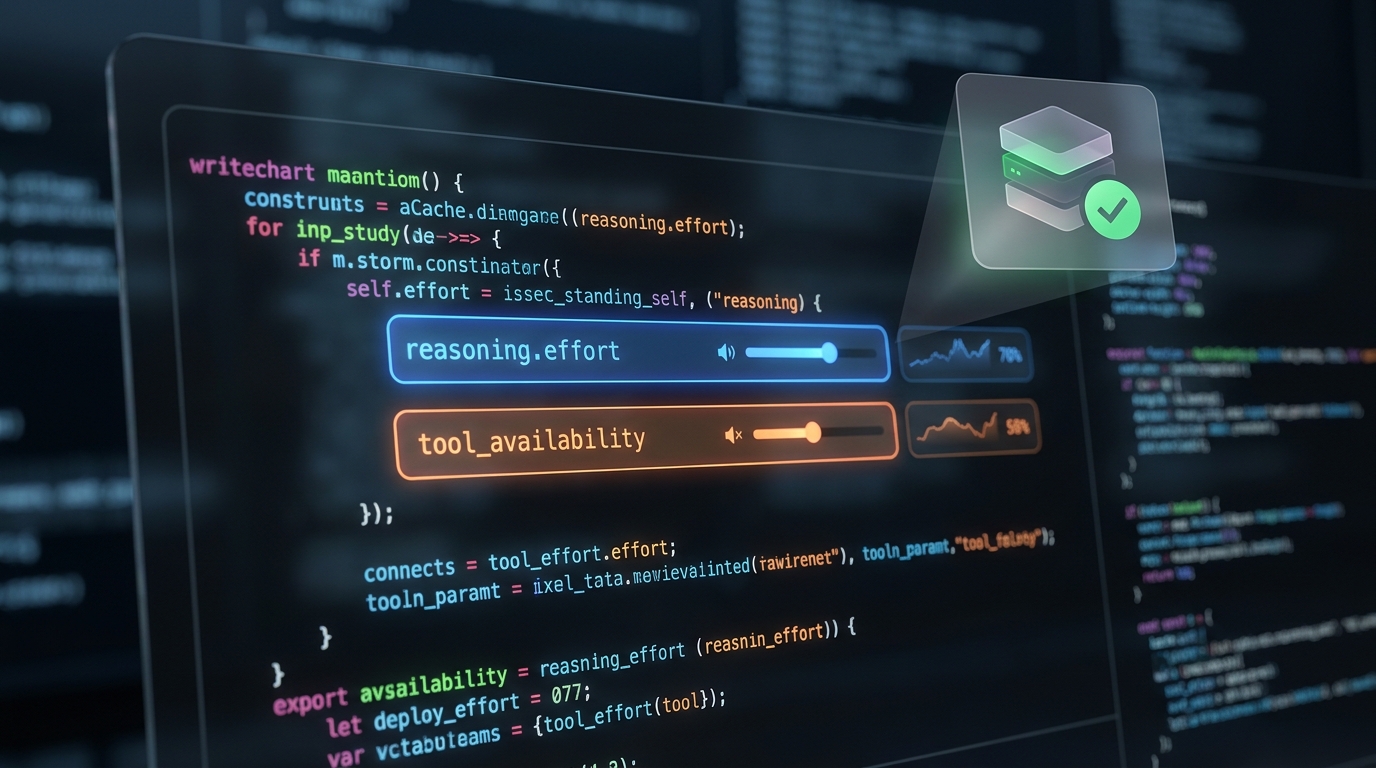
Dynamically adjusting agent parameters like reasoning effort no longer breaks your cache, preserving efficiency.
Putting It All Together: Your Action Plan 🚀
So, how do you start leveraging these powerful new prompt caching features? First, ensure you're using GPT-6 Sol or Luna models for your applications. Then, identify parts of your prompts that are static or frequently repeated. These are prime candidates for caching.
Experiment with explicit breakpoints to mark the end of your static context. Use the prompt cache diagnostics to understand your cache hit rates and identify areas for improvement. Monitor your overall performance on the Prompt Caching Dashboard. By actively managing your caching strategy, you'll not only save money but also build faster, more responsive, and ultimately, more capable AI applications. It's time to build smarter, not harder!
💡 Pro Tip: Always test your prompt changes with cache diagnostics enabled to understand their impact on cache hit rates before deploying to production.
Key Takeaways
- GPT-6 Sol and Luna offer 90% discounts on cached input-token reads and 50% API price reductions, slashing LLM costs.
- Explicit breakpoints give you granular control over what gets cached, optimizing for static context reuse.
- Prompt cache diagnostics and a dedicated dashboard provide crucial insights into cache performance and reasons for misses.
- Dynamic adjustments to agent parameters (like 'reasoning.effort') no longer break cache, enhancing agent flexibility and efficiency.
- These advancements make sophisticated AI agents and long-context applications significantly more practical and affordable for creators and businesses.
Related on Tech4SSD 🔗
- Custom AI Tools for Creative Workflows: Lessons from Google Flow (2026)
- Teaching Everyday AI Skills: Practical ChatGPT Workflows for Non-Technical Users (2026)
- Integrating Autonomous AI Agents into Software Engineering (2026)
📩 Want the freshest AI trends every week?
Subscribe to Tech4SSD — practical AI tools and trends, explained for everyone. Free. Subscribe →
Advertisement
Frequently Asked Questions
What is prompt caching and why is it important for LLMs?
Prompt caching stores frequently used parts of your LLM prompts (like system instructions or conversation history) so the model doesn't have to re-process them every time. This significantly reduces API costs and improves latency, making your AI applications faster and more affordable.
How much can I actually save with GPT-6's new caching features?
With GPT-6 Sol and Luna, you can get a 90% discount on cached input-token reads. Combined with a 50% reduction in base API prices compared to GPT-5.6 promotional rates, the potential for cost savings is substantial, especially for applications with high context reuse.
What are explicit breakpoints and how do I use them?
Explicit breakpoints allow you to mark a specific point in your prompt. Content before the breakpoint is eligible for caching, while content after it (usually dynamic user input) is processed fresh. This gives you precise control to optimize for content reuse and avoid unnecessary charges. You'll specify them in your API calls.
Can I see if my cache is actually working?
Absolutely! GPT-5.6 and later models offer prompt cache diagnostics that tell you why a cache might have missed. Additionally, a dedicated Prompt Caching Dashboard provides an overview of your cache hit rates and performance across your entire application, helping you fine-tune your caching strategy.
Final Word
The advancements in prompt caching with OpenAI's GPT-6 Sol and Luna models are more than just technical upgrades; they're a fundamental shift in how we can build and deploy sophisticated AI applications. By giving you granular control, powerful diagnostics, and significant cost reductions, OpenAI is empowering every builder to create more efficient, responsive, and economically viable AI tools.
Don't let token costs hold you back from your next big idea. Embrace these new caching techniques, optimize your workflows, and watch your AI projects soar to new heights. The future of practical, affordable AI is here, and you're ready to build it! 💡
Sources & Further Reading
- Prompt cache diagnostics | OpenAI API
- https://developers.openai.com/api/docs/guides/prompt-caching?prompt-cache-api=responses
- Prompt caching | OpenAI API
- https://developers.openai.com/api/docs/guides/prompt-caching.md
- Prompt Caching 201
- Rethinking skills and prompts for GPT-6 Astra | OpenAI Developers
- Model guidance | OpenAI API
- Introducing GPT-6 Sol and Luna | OpenAI
- Latency optimization | OpenAI API
- The builder's guide to GPT‑5.6 | OpenAI
AI tools and features change fast — verify current options before relying on them. — Tech4SSD Editorial
Discussion
Have a question or something to add?
Join the discussion on Blogger