Falcon OCR Arabic: Ever wished you could effortlessly pull text, tables, and even formulas from your Arabic documents and images? Well, buckle up, because the **Falcon OCR Arabic** model is here to make that a reality! This isn't just another optical character recognition (OCR) tool; it's a compact powerhouse designed specifically for Arabic document processing, bringing advanced AI capabilities right to your fingertips. 🚀
In this article, we’re going to dive deep into what makes Falcon OCR Arabic so special. We'll explore its unique architecture, how it tackles complex document elements, and why its efficiency makes it a game-changer for creators, students, and small business owners working with Arabic content. Get ready to demystify advanced AI and see how you can leverage this incredible technology!
Advertisement
Meet Falcon OCR Arabic: The Compact Powerhouse 💡
At its core, Falcon OCR Arabic is a 270-million parameter vision-language model (VLM) developed by TII (Technology Innovation Institute). What does that mean for you? It means you're getting a highly capable AI model that's significantly smaller and more efficient than many of its competitors. Think of it as a finely tuned sports car compared to a bulky truck – it gets the job done fast and without wasting resources.
This model isn't just about raw speed; it's about smart design. Unlike many traditional OCR systems that might use separate steps for different tasks, Falcon OCR Arabic uses a unified approach. This makes it incredibly versatile for handling a wide range of Arabic documents, from scanned papers to digital forms, all while keeping things streamlined and effective.
Unified Architecture: Smarter, Faster Processing ⚡
One of the coolest things about Falcon OCR Arabic is its "early-fusion" architecture. Imagine a single brain that processes both what it sees (image patches) and what it's trying to understand (text tokens) at the exact same time, from the very first step. That's what this model does!
This single Transformer architecture means less back-and-forth between different parts of the model, leading to lower latency and much higher throughput. For you, this translates to faster results when you're processing your documents, whether it's a single page or a whole stack. It's designed to be quick and efficient, helping you save precious time.
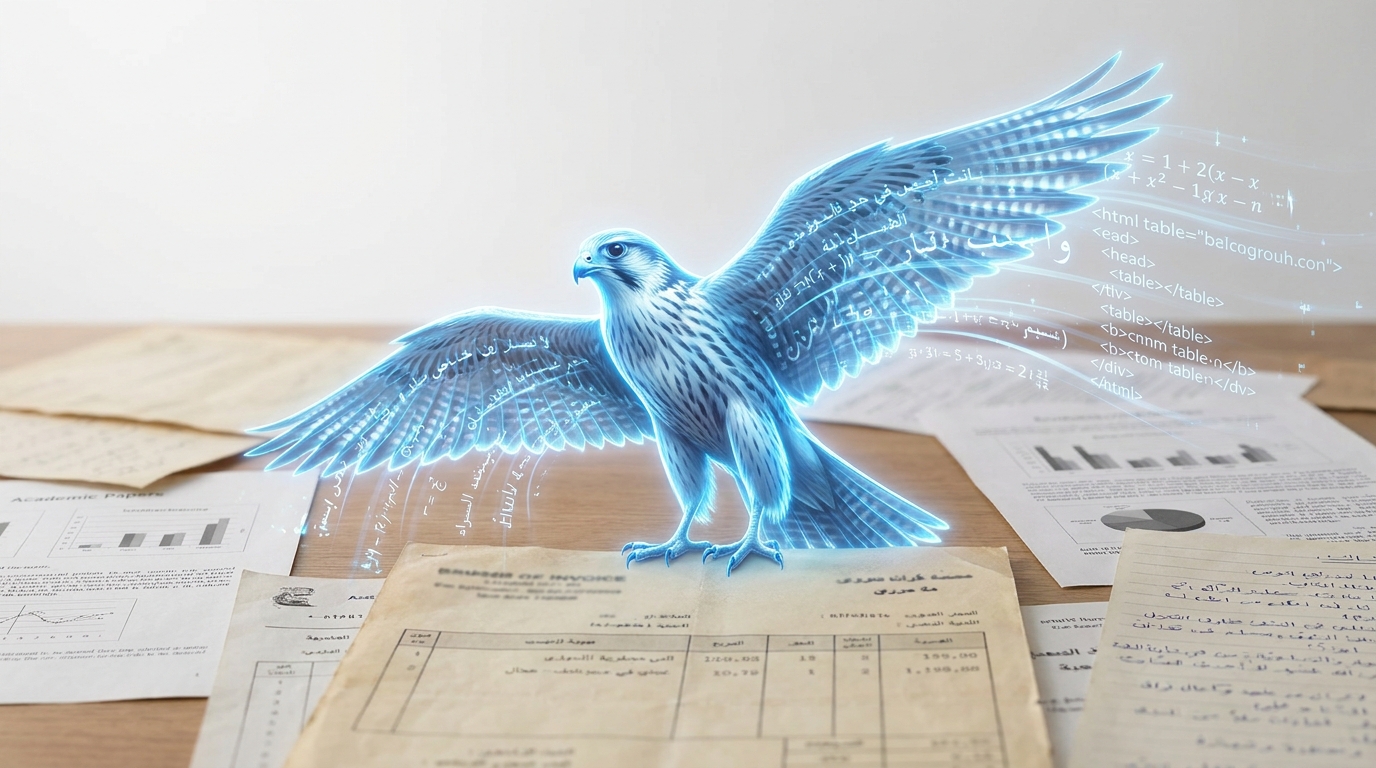
Falcon OCR Arabic intelligently processes visual and textual information simultaneously for peak efficiency.
Beyond Plain Text: Formulas and Tables Too! 📊
Falcon OCR Arabic isn't just for extracting simple paragraphs. It's incredibly smart about different types of information. Need to pull out a complex mathematical formula from an Arabic science paper? It can give you the LaTeX code for that! Working with financial reports? It can extract tables and output them as HTML, ready for you to drop into a spreadsheet or web page.
This ability to understand and output structured data like LaTeX and HTML, alongside plain text, is a huge advantage. It means you're not just getting raw text; you're getting *meaningful* data that retains its original structure and context. This is a game-changer for anyone dealing with technical or data-rich Arabic documents.
Performance That Impresses: Speed and Accuracy 🚀
When it comes to performance, Falcon OCR Arabic holds its own against much larger models. It achieved impressive scores on benchmarks like olmOCR (80.3) and OmniDocBench (88.6). But here's the kicker: it does this with the highest throughput among open-source OCR models. This means it can process more documents, faster, than many alternatives.
For creators and small businesses, this combination of accuracy and speed is invaluable. Whether you're digitizing archives, processing customer forms, or analyzing research papers, Falcon OCR Arabic provides reliable results without making you wait. It's about getting the job done right, quickly.
Advertisement
Tackling Hallucinations: More Reliable Results ✅
One common challenge with AI models is "hallucinations" – when the AI generates incorrect or made-up information. TII has actively addressed this in Falcon OCR Arabic through a technique called GRPO (element-wise reward attribution) during post-training. This helps the model be more truthful and accurate, especially when dealing with tricky elements like tables and formulas.
This focus on reducing hallucinations means you can trust the output from Falcon OCR Arabic more. For critical tasks like data entry, legal document processing, or academic research, accuracy is paramount. Knowing the model has been fine-tuned for correctness gives you peace of mind.
- Enhanced Accuracy GRPO post-training specifically targets and reduces instances of the model generating incorrect information, particularly for complex structures.
- Improved Trustworthiness This mitigation makes the extracted data more reliable for sensitive applications, ensuring the integrity of your Arabic document processing.
Deployment Made Easy: Get Started Quickly 🛠️
Thinking about integrating Falcon OCR Arabic into your own projects? TII has made deployment straightforward. It supports a Docker-based vLLM-backed inference server, which sounds technical but essentially means it's set up for efficient, high-volume use. This server can handle approximately 6,000 tokens per second, ensuring your applications run smoothly.
You have options too: you can use it for end-to-end OCR, or for very dense documents, you can opt for a two-stage layout + OCR pipeline. This flexibility allows developers to tailor its use to specific needs, making it a powerful tool for building custom document understanding solutions for Arabic content. You can explore the model and its capabilities on Hugging Face.

Deploying Falcon OCR Arabic is streamlined for high performance and scalability.
Why Falcon OCR Arabic Matters for You 🌍
If you're a developer looking to add advanced Arabic document understanding to your applications, Falcon OCR Arabic offers a compelling solution. Its compact size means lower operational costs and faster processing, which is crucial for scalable deployments. The unified architecture simplifies development, letting you focus on building great features rather than wrestling with complex integrations.
For students and small business owners, this means powerful tools for digitizing and analyzing Arabic documents are becoming more accessible and efficient. Whether it’s extracting data from invoices, converting handwritten notes, or making research papers searchable, Falcon OCR Arabic empowers you to do more with your Arabic content. It’s about democratizing advanced AI for everyday use. Visit TII's Falcon Perception page for more details.
💡 Pro Tip: When working with Falcon OCR Arabic, consider using its HTML output for tables. This preserves the structure, making data analysis and integration into other tools much smoother than plain text.
Key Takeaways
- Falcon OCR Arabic is a compact (270M parameters) yet powerful vision-language model for Arabic document OCR.
- Its early-fusion architecture processes images and text simultaneously, leading to high throughput and low latency.
- It can extract plain text, LaTeX for formulas, and HTML for tables, offering versatile document understanding.
- Post-training with GRPO significantly reduces hallucinations, improving the accuracy of extracted tables and formulas.
- Deployment is efficient via a Docker-based vLLM server, capable of processing approximately 6,000 tokens per second.
Related on Tech4SSD 🔗
- Accelerating Vision-Language Inference with LFM2.5-VL-DSpark (2026)
- Open-Sourcing AstaBrief: Fast AI Report Generation for Developer Workflows (2026)
📩 Want the freshest AI trends every week?
Subscribe to Tech4SSD — practical AI tools and trends, explained for everyone. Free. Subscribe →
Advertisement
Frequently Asked Questions
What makes Falcon OCR Arabic different from other OCR models?
Its key differentiator is its compact 270M parameter size combined with an early-fusion vision-language architecture. This allows it to process image patches and text tokens simultaneously, leading to higher efficiency, lower latency, and impressive performance, especially for Arabic documents, compared to larger models.
Can Falcon OCR Arabic handle handwritten Arabic text?
While the model is highly capable for diverse document types, its primary focus and benchmarks are typically on printed or digital text. Performance on handwritten Arabic can vary greatly depending on legibility and specific use cases. For critical applications, always test with your specific handwritten data.
Is Falcon OCR Arabic open source?
Yes, the Falcon OCR model, including its Arabic capabilities, is available on Hugging Face, indicating its open-source nature. This allows developers and researchers to access, use, and build upon the model for their projects.
How does Falcon OCR Arabic handle different output formats like LaTeX or HTML?
The model uses a prompt-based system to switch between output formats. By providing the appropriate prompt, you can instruct the model to generate plain text, LaTeX for mathematical formulas, or HTML for tables, offering a unified and flexible approach to structured data extraction.
Final Word
Falcon OCR Arabic is more than just an OCR tool; it's a testament to how intelligent design can lead to powerful, efficient AI. Its ability to accurately extract complex information from Arabic documents, all within a compact and high-throughput package, truly sets it apart. Whether you're a developer building the next big app or a small business owner looking to streamline your document workflow, this model offers a robust and reliable solution.
The future of document understanding is here, and it's looking incredibly bright and efficient with Falcon OCR Arabic leading the charge. Don't just read about it; go explore its potential and see how it can transform your work! ✨
Sources & Further Reading
- tiiuae/Falcon-OCR · Hugging Face
- Falcon Perception - Falcon LLM
- README.md · tiiuae/Falcon-OCR at main
- Update README.md · tiiuae/Falcon-OCR at 57d4c10
- tiiuae/Falcon-OCR at main
- README.md · tiiuae/Falcon-OCR at f22f735100a3b32735a3d3cdd9abdfe442d7e9eb
- Falcon Perception
- https://huggingface.co/tiiuae/Falcon-OCR/raw/3e0106ea4ad0bd041e31ace40a1ef91d09f5d4fb/README.md
- Readme
- Readme
AI tools and features change fast — verify current options before relying on them. — Tech4SSD Editorial
Discussion
Have a question or something to add?
Join the discussion on Blogger