Azure AMD AI infrastructure: here is what the official release means in practice. Ever feel like your AI projects are hitting a wall, waiting for more processing power? You're not alone! The world of artificial intelligence and high-performance computing (HPC) demands serious muscle, and Microsoft Azure is stepping up its game. They're rolling out a major expansion to their Azure AMD AI infrastructure, introducing three brand-new virtual machine (VM) series designed to tackle your toughest tasks head-on. This isn't just about more power; it's about *smarter* power, tailored for specific, demanding workloads. 🚀
In this article, we'll break down exactly what these new AMD-powered VMs — HDv2, HXv2, and ND MI455X v7 — mean for you. We'll demystify the tech, show you where they shine, and explain how this expansion can supercharge your AI and HPC projects. Get ready to understand how Azure is giving creators, students, and small businesses the tools to innovate faster and more efficiently than ever before.
Advertisement
Why Specialized VMs Matter for AI and HPC 💡
Think of your computer like a toolbox. For simple tasks, a general-purpose hammer works fine. But if you're building intricate furniture or delicate electronics, you need specialized tools: a precision screwdriver, a fine-toothed saw. The same goes for cloud computing, especially with AI and HPC.
These aren't your everyday web browsing tasks. AI models need massive amounts of data processed quickly, complex simulations require immense computational power, and cutting-edge designs demand specific hardware configurations. General-purpose VMs just can't keep up. That's why Microsoft Azure, in collaboration with AMD, is focusing on these specialized virtual machines. They're like those precision tools, custom-built to excel at very particular, very demanding jobs. This means less time waiting, more time creating, and ultimately, better results for your projects.
This strategic move by Microsoft isn't just about keeping up; it's about leading the charge in providing the exact computational resources needed for the next wave of innovation. It ensures that whether you're training a complex AI model or running a massive data simulation, you have the optimal environment for success.
The Power Behind the Punch: AMD's Role 🥊
You might be wondering, why AMD? Well, AMD has been making serious waves in the datacenter and high-performance computing space. Their EPYC processors are known for their high core counts, impressive memory bandwidth, and energy efficiency. This makes them ideal partners for Microsoft's Azure cloud, which needs to deliver top-tier performance at scale.
The new VMs leverage AMD's latest innovations, including their next-generation EPYC datacenter processors and the brand-new Helios AI platform. This isn't just a simple chip swap; it's a deep collaboration that integrates AMD's cutting-edge hardware directly into Azure's robust cloud infrastructure. The result? Virtual machines that are not only powerful but also optimized to work seamlessly within the Azure ecosystem, giving you a reliable and high-performing foundation for your work.
This partnership isn't new; Microsoft has been integrating AMD technology into Azure for years. In fact, they recently announced the general availability of Azure Da/Ea/Fasv7-series VMs based on 5th Gen AMD EPYC™ (Turin) processors, which offered up to 35% better CPU performance compared to their predecessors. This continuous evolution means you're always getting access to some of the most advanced computing power available in the cloud.
Meet the New Azure AMD AI Infrastructure Stars ✨
Let's dive into the specifics of these three new virtual machine series. Each one is designed with a particular set of demanding tasks in mind, ensuring you get the right tool for your specific job. No more trying to fit a square peg in a round hole!
These aren't just incremental updates; they represent significant leaps in capability, especially for workloads that are traditionally resource-intensive. Understanding their unique strengths will help you choose the best option for your next big project.
🟦 HDv2 Series: The Data Processing Powerhouse
Got mountains of data to crunch? The HDv2 VMs are built for you. These machines are absolute beasts when it comes to data processing and other compute-intensive tasks. They feature nearly 500 physical 6th Gen AMD EPYC CPU cores, 4 terabytes of RAM, and a whopping 32 terabytes of local NVMe storage. Plus, with 400 Gb Azure Boost networking, your data moves at lightning speed.
This combination makes HDv2 perfect for applications like large-scale data analytics, complex simulations, and high-throughput computing. If your project involves sifting through vast datasets or running intricate computational models, the HDv2 series will be your new best friend.
🟥 HXv2 Series: Engineering Excellence for EDA
For our friends in the world of electronic design automation (EDA), the HXv2 VMs are a game-changer. These build upon the success of the previous HX series, which already saw significant adoption among silicon design firms thanks to AMD's 3D V-cache technology. If you're designing chips, running complex simulations for semiconductor development, or engaging in other highly specialized engineering tasks, HXv2 is engineered to accelerate your workflow.
The enhancements in the HXv2 series mean even faster turnaround times for design iterations and more complex simulations, directly impacting the speed and efficiency of bringing new hardware to market. It's all about giving engineers the computational headroom they need to innovate without bottlenecks.
🟪 ND MI455X v7 Series: AI Inference Unleashed
When it comes to putting your trained AI models to work – what we call 'AI inference' – the ND MI455X v7 VMs are here to deliver. These machines are specifically optimized for high-performance AI inference workloads, leveraging AMD's advanced Helios AI platform. This means faster responses, more efficient processing of AI queries, and the ability to handle larger volumes of AI inference tasks simultaneously.
Whether you're deploying a large language model, running real-time image recognition, or powering intelligent automation, the ND MI455X v7 series provides the dedicated GPU power and optimized architecture to make your AI applications sing. It's about bringing your AI creations to life with speed and precision.
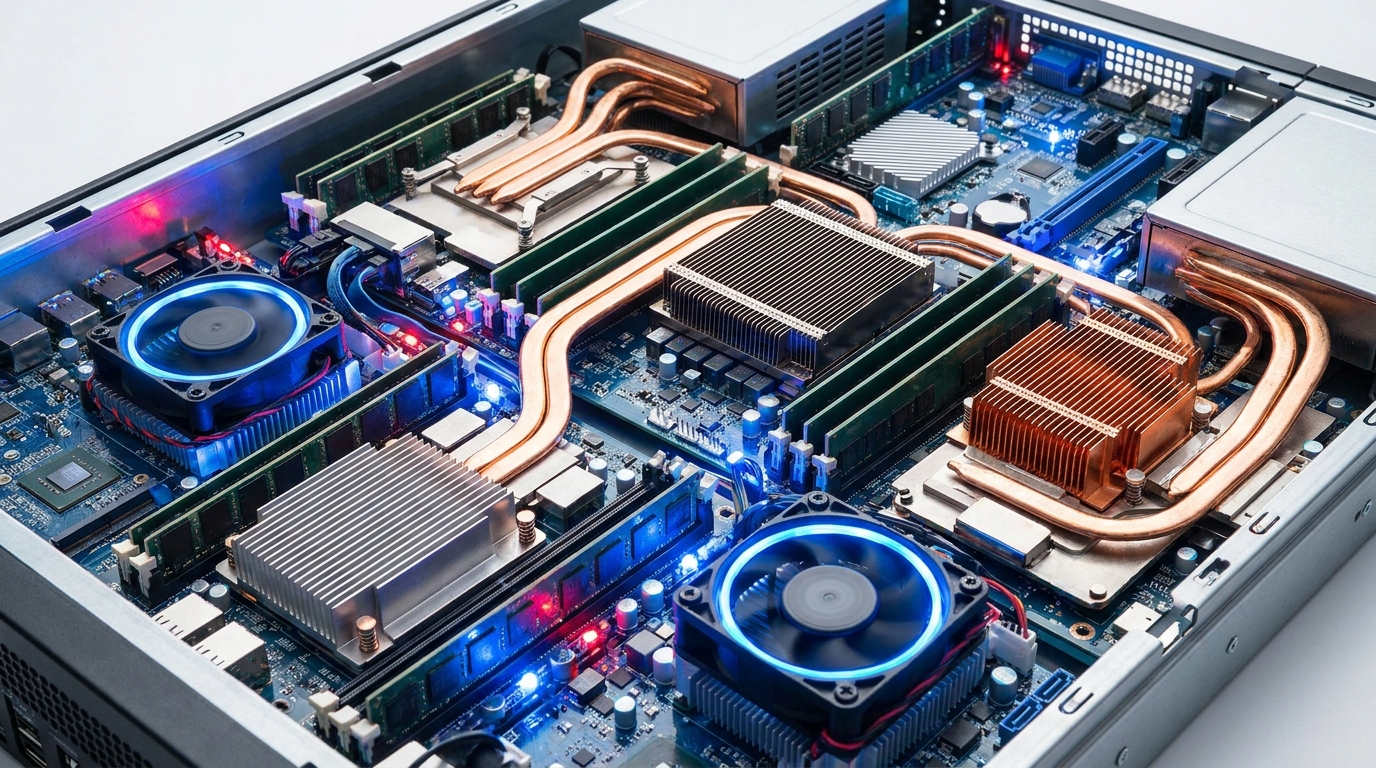
The heart of high-performance computing: where raw power meets intricate design.
What This Means for You: Performance, Efficiency, and Scale 📈
So, how does this all translate into real-world benefits for you, the everyday creator, student, or small-business owner? It boils down to three key advantages: performance, efficiency, and scalability.
Performance: With specialized VMs, your applications run faster. Whether it's processing data, simulating designs, or running AI models, you'll see quicker results. This means less waiting and more doing, which is crucial when you're on a deadline or iterating on a new idea.
Efficiency: By using the right tool for the job, you're also more efficient. These VMs are optimized for specific workloads, meaning they can accomplish tasks with less wasted computational power. This can translate into cost savings, as you're paying for precisely what you need, not for general-purpose resources that aren't fully utilized.
Scalability: Cloud computing's biggest strength is its ability to scale. Need more power for a sudden spike in demand? Azure lets you spin up more of these specialized VMs as needed, and then scale back down when the peak passes. This flexibility ensures your projects can grow without hitting hardware limitations, a huge win for dynamic workloads. You can learn more about Azure's overall cloud capabilities on their official site: Cloud Computing Services | Microsoft Azure.
Advertisement
Beyond the Headlines: Practical Applications 🛠️
Let's get practical. How might these new Azure AMD AI infrastructure VMs actually impact your projects?
For students working on a data science capstone, the HDv2 could dramatically cut down the time spent on data preprocessing. For a small startup developing a new AI-powered recommendation engine, the ND MI455X v7 could mean faster, more responsive AI inference for their users. And for a freelance designer dabbling in complex simulations for product development, the HXv2 could unlock new levels of detail and speed in their work.
This expansion democratizes access to high-end computing. You don't need to own a supercomputer to tackle complex problems anymore; you can rent the exact power you need, when you need it, from Azure. It's about empowering you to take on bigger challenges without the massive upfront investment.
- Data Analytics & Research: Leverage HDv2 for rapid processing of large datasets, accelerating insights for market research, scientific studies, or financial modeling.
- Product Design & Engineering: Utilize HXv2 for faster simulations and complex design iterations in fields like automotive, aerospace, or semiconductor development, significantly shortening design cycles.
- AI-Powered Services: Deploy AI inference models with ND MI455X v7 for real-time applications such as intelligent chatbots, personalized content delivery, or advanced computer vision systems, ensuring snappy performance for your users.
- Content Creation & Media: While not explicitly for media, the raw processing power of HDv2 could aid in rendering complex 3D scenes or high-resolution video processing, especially when combined with other specialized services.
Looking Ahead: The Future of Cloud AI 🔮
This move by Microsoft and AMD is a clear indicator of where cloud computing is headed: toward increasingly specialized and powerful infrastructure designed to meet the insatiable demands of AI and HPC. As AI models grow larger and more complex, and as scientific and engineering challenges become more intricate, the need for tailored, high-performance computing resources will only intensify.
What does this mean for you? It means that the tools you need to innovate will continue to evolve, becoming more powerful and more accessible. Keeping an eye on these developments ensures you're always equipped with the latest technology to bring your most ambitious projects to life. It's an exciting time to be a creator in the cloud!
The continuous innovation from providers like Microsoft Azure and hardware partners like AMD ensures that the barrier to entry for cutting-edge AI and HPC workloads continues to drop, empowering a broader range of users to leverage these powerful technologies. This trend is a win for everyone looking to push the boundaries of what's possible.
The seamless flow of data and intelligence in the cloud, powered by advanced infrastructure.
💡 Pro Tip: When choosing an Azure VM, always match the VM series to your specific workload (e.g., HDv2 for heavy data crunching, ND MI455X v7 for AI inference) to optimize both performance and cost.
Key Takeaways
- Microsoft Azure is expanding its AI and HPC infrastructure with three new AMD-powered VM series: HDv2, HXv2, and ND MI455X v7.
- These VMs are highly specialized: HDv2 for data processing, HXv2 for electronic design automation (EDA), and ND MI455X v7 for AI inference.
- The new offerings leverage AMD's latest Helios AI platform and next-generation EPYC datacenter processors for superior performance.
- Benefits include enhanced performance, greater efficiency, and improved scalability for demanding AI and HPC workloads.
- This expansion provides creators, students, and small businesses with more powerful, tailored, and accessible cloud computing options.
Related on Tech4SSD 🔗
- Open-Weight AI Models in 2026: Your Guide to Unlocked Power 🚀
- Beyond Chatbots: Building Your Specialized AI Productivity Stack for 2026
📩 Want the freshest AI trends every week?
Subscribe to Tech4SSD — practical AI tools and trends, explained for everyone. Free. Subscribe →
Advertisement
Frequently Asked Questions
What's the main difference between HDv2, HXv2, and ND MI455X v7 VMs?
Each VM series is optimized for a specific type of demanding workload. HDv2 is for heavy data processing, HXv2 is tailored for electronic design automation (EDA) and complex simulations, and ND MI455X v7 is specifically designed for high-performance AI inference tasks.
How does AMD's technology benefit these new Azure VMs?
AMD's next-generation EPYC datacenter processors and the new Helios AI platform provide high core counts, significant memory bandwidth, and specialized AI acceleration, leading to superior performance and efficiency for the targeted workloads within Azure.
Are these new VMs suitable for small businesses or individual creators?
Absolutely! While powerful, cloud VMs are scalable. You can provision the resources you need for specific projects, making high-performance computing accessible without massive upfront investment. This allows small businesses and creators to tackle projects that previously required significant hardware budgets.
Where can I find more technical details about these new Azure VMs?
You can find more technical specifications and details on the official Microsoft Azure documentation pages, specifically under their Virtual Machines section. The Microsoft Blog also often provides in-depth announcements like this one: Microsoft expands Azure AI and HPC infrastructure with AMD.
Final Word
The expansion of Microsoft Azure's AMD AI infrastructure with the HDv2, HXv2, and ND MI455X v7 VMs is more than just a technical upgrade; it's a strategic move that empowers a wider range of users to harness the full potential of AI and high-performance computing. By offering specialized, high-power virtual machines, Azure is making cutting-edge technology more accessible and efficient for everyone, from data scientists to silicon designers and AI developers.
This means you have better tools at your fingertips to innovate, create, and solve complex problems faster than ever before. Embrace these powerful new options and unlock new possibilities for your projects. Your next big breakthrough might just be a VM away! ✨
Sources & Further Reading
- Microsoft expands Azure AI and HPC infrastructure with AMD - The Official Microsoft Blog
- Cloud Computing Services | Microsoft Azure
- Announcing General Availability of Azure Da/Ea/Fasv7-series VMs based on AMD ‘Turin’ processors | Microsoft Community Hub
- Announcing General Availability of Azure Dl/D/Esv7-series VMs based on Intel® Xeon® 6 processors | Microsoft Community Hub
- NVv4 size series - Azure Virtual Machines | Microsoft Learn
- ND size series - Azure Virtual Machines | Microsoft Learn
AI tools and features change fast — verify current options before relying on them. — Tech4SSD Editorial
Discussion
Have a question or something to add?
Join the discussion on Blogger