Hey creators, students, and small business owners! Get ready for a major shake-up in the AI world. We're diving deep into the exciting showdown between Anthropic's new mid-tier model, Claude Sonnet 5, and OpenAI's flagship, GPT-5.5. This isn't just another tech spec comparison; it's about real-world impact for *you*! 🚀
In this post, we'll break down why Sonnet 5 is turning heads, how it stacks up against GPT-5.5 on crucial benchmarks (especially for coding!), and what its surprisingly low cost means for your projects and budgets. You'll walk away understanding which AI powerhouse might be your next secret weapon.
Advertisement
The AI Landscape Just Shifted: Sonnet 5 Arrives 🌍
Remember when only the 'flagship' models ruled the roost? Well, 2026 is bringing a new narrative. Anthropic's Claude Sonnet 5, fresh on the scene, isn't just good; it's challenging the top dogs.
It's designed to be Anthropic's workhorse, their 'mid-tier' offering. But don't let that label fool you. Early results show it's punching way above its weight class, especially when it comes to tasks that matter most to builders and developers.
Performance Head-to-Head: Where Sonnet 5 Shines ✨
This is where it gets really interesting. When we look at direct comparisons on several key benchmarks, Claude Sonnet 5 doesn't just compete with GPT-5.5; it often *outperforms* it. And remember, GPT-5.5 is OpenAI's *flagship* model.
Specifically, for those of you building and coding, Sonnet 5 shows a clear lead. This includes complex 'agentic coding' tasks – think AI that can understand a problem, write code, test it, and fix errors. That's a huge deal for efficiency.
- Coding Powerhouse: Sonnet 5 leads GPT-5.5 on all six directly comparable benchmarks. This includes impressive scores on SWE-bench Pro (63.2% vs 58.6%) and Terminal-Bench 2.1 (80.4% vs 78.2%). More accurate code, less debugging for you!
- Overall Benchmark Superiority: Across the board, if a benchmark is directly comparable, Sonnet 5 generally comes out on top. This isn't just a fluke; it suggests a robust and capable model.
The Cost Advantage: More Bang for Your Buck 💰
Performance is one thing, but cost is often the deciding factor for creators and small businesses. And this is where Claude Sonnet 5 truly changes the game. It's not just better on some benchmarks; it's significantly cheaper.
Imagine getting superior results for less money. That's exactly what Sonnet 5 is offering. This could drastically impact your project budgets and the viability of new AI-powered tools and services you're building.
| Metric | Claude Sonnet 5 (Standard Pricing) | GPT-5.5 (Standard Pricing) |
|---|---|---|
| Input Cost (per MTok) | $3 | $5 |
| Output Cost (per MTok) | $15 | $30 |
| Cost Savings (Sonnet 5 vs. GPT-5.5) | 40% less for input | 50% less for output |
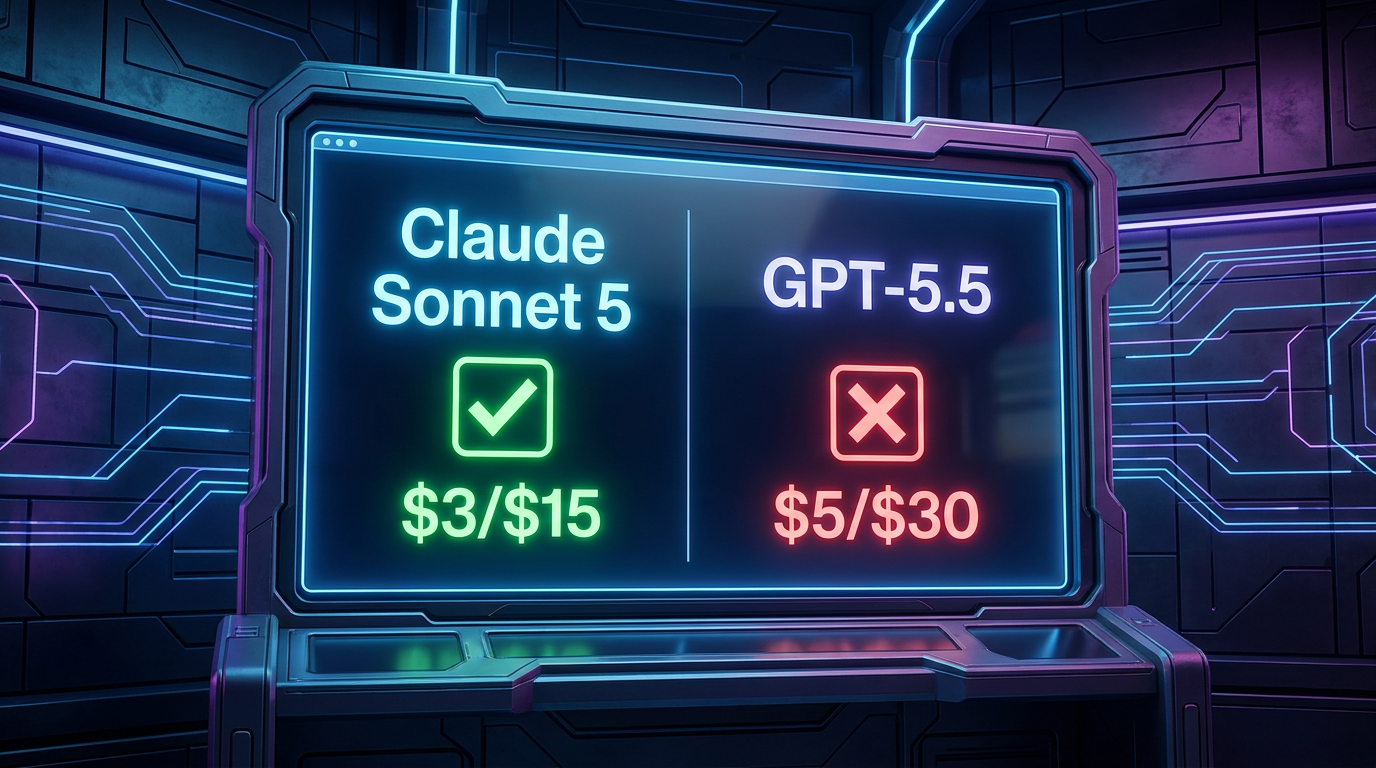
Sonnet 5 offers significant cost savings, making powerful AI more accessible.
Where GPT-5.5 Still Holds Its Own 👑
Now, let's be fair. GPT-5.5 isn't just going to roll over. OpenAI's flagship still has some key advantages that make it a powerful contender, especially in certain areas. It's important to understand these nuances when choosing your AI tool.
Ecosystem and brand recognition are big factors. Plus, OpenAI has invested heavily in specific areas where their models still shine.
- Ecosystem Advantage: GPT-5.5 benefits from OpenAI's vast ecosystem, including its widely popular ChatGPT interface and specialized models like Codex. This means more integrations and a broader user base.
- Specific Benchmarks: While Sonnet 5 leads on *comparable* benchmarks, GPT-5.5 has an edge on some OpenAI-specific tests, like ARC-AGI-2 (85.0% vs ~84.7%). It also offers a five-level reasoning-effort scale, giving developers more granular control.
Advertisement
Context Windows and Latency: The Nitty-Gritty Details ⚙️
Beyond raw performance and cost, other technical details matter. Things like how much information an AI can 'remember' (its context window) and how quickly it responds (latency) can make a big difference in real-world applications.
Both models are pushing the boundaries here, but there are subtle differences worth noting for those looking for peak efficiency.
🟦 Context Window:
Both Sonnet 5 and GPT-5.5 feature an impressive 1M token context window. This means they can process and remember very long conversations or documents. GPT-5.5 slightly edges out with 1.05M tokens, a minor but potentially useful difference for extremely long inputs. Think of it as the AI's short-term memory capacity.
🟥 Latency:
Sonnet 5 is noted for faster latency. This means it responds more quickly, which can be crucial for real-time applications, interactive tools, or workflows where speed is paramount. Every millisecond counts when you're building a snappy user experience!
Why This Matters for *You* 💡
So, what does this all mean for you, the everyday creator, student, or small business owner? This shift is huge. It means more powerful AI is becoming more accessible and affordable. You don't necessarily need the 'flagship' anymore to get top-tier results.
If you're a developer, this means you can potentially achieve better coding results for less money. If you're using AI for content creation, data analysis, or automating tasks, Sonnet 5 offers a compelling alternative. It drives innovation by creating more competition and better value for everyone. The AI tool landscape is rapidly evolving, and models like Sonnet 5 are proof.

Choosing the right AI model can significantly impact your project's success and budget.
💡 Pro Tip: Always test new AI models with your specific use cases. Benchmarks are a guide, but your real-world application will determine the true champion for *your* needs!
Key Takeaways
- Claude Sonnet 5, Anthropic's mid-tier model, outperforms OpenAI's flagship GPT-5.5 on several key coding benchmarks.
- Sonnet 5 is significantly more cost-effective, offering 40% cheaper input and 50% cheaper output tokens.
- GPT-5.5 still holds advantages in ecosystem integration and some specific OpenAI-developed benchmarks.
- Both models boast a 1M token context window, with Sonnet 5 noted for faster response times.
- This shift means powerful AI is becoming more accessible and affordable for developers and creators.
Related on Tech4SSD 🔗
- AI Tools for Students in 2026: Your Ultimate Guide to Smarter Learning
- AI Note-Taking Apps in 2026: From Transcription to Actionable Intelligence (2026)
📩 Want the freshest AI trends every week?
Subscribe to Tech4SSD — practical AI tools and trends, explained for everyone. Free. Subscribe →
Advertisement
Frequently Asked Questions
Is Claude Sonnet 5 really better than GPT-5.5 for all tasks?
Not for *all* tasks, but it shows superior performance on directly comparable benchmarks, especially in agentic coding. GPT-5.5 still leads in certain OpenAI-specific tests and benefits from a broader ecosystem.
How much cheaper is Claude Sonnet 5?
Sonnet 5 is 40% cheaper for input tokens and 50% cheaper for output tokens compared to GPT-5.5's standard pricing. This can lead to significant cost savings for high-volume usage.
What is a 'mid-tier' model, and why is Sonnet 5's performance so surprising?
A 'mid-tier' model is typically positioned between a smaller, faster model and a larger, more powerful (and expensive) flagship model. Sonnet 5's performance is surprising because it's outperforming OpenAI's *flagship* model on key benchmarks, blurring the lines between model tiers.
Where can I try Claude Sonnet 5?
Anthropic typically offers access through their API for developers. Check their official documentation for the latest on access and integration.
Final Word
The AI world is dynamic, and Anthropic's Claude Sonnet 5 is a prime example of how quickly things can change. What was once considered a 'mid-tier' offering is now challenging the status quo, delivering top-tier performance at a fraction of the cost. This is fantastic news for everyone, as it fuels competition and innovation, ultimately leading to better and more affordable tools for *you*.
So, whether you're coding, creating, or simply curious, keep an eye on Sonnet 5. It might just be the AI partner you've been waiting for to supercharge your projects without breaking the bank. The future of AI is bright, and it's getting smarter and more accessible every day! ✨
AI tools and features change fast — verify current options before relying on them. — Tech4SSD Editorial
Discussion
Have a question or something to add?
Join the discussion on Blogger