Long-context models keep getting bigger, and yet every serious AI product in 2026 still leans on the same trick to actually know things: RAG. If your AI hallucinates, forgets your docs, or makes things up about your own company — you don't need a smarter model. You need retrieval.
RAG (Retrieval Augmented Generation) is the cheapest, fastest way to make an AI read your documents instead of guessing. You chunk your data, turn it into vectors, store it in a vector database, retrieve the most relevant chunks at query time, and pass them to the model as context. This guide covers the full 2026 stack — Pinecone, Weaviate, Qdrant, LlamaIndex, LangChain — plus the architecture, the Python snippets, the mistakes that wreck retrieval quality, and exactly when to reach for RAG instead of MCP or a million-token context window.
What Is RAG (Retrieval Augmented Generation)?
RAG explained in one line: instead of relying only on what the model learned during training, you feed it the specific documents it needs at the moment of the question.
The model still does the language work — understanding the question, writing the answer. But the facts come from a retrieval step that pulls relevant snippets from a private knowledge base. You're separating the two jobs an LLM is bad at combining: reasoning and remembering.
That separation is the whole point. A frozen model can't know your internal wiki, your support tickets, last quarter's product specs, or yesterday's pricing change. RAG plugs that gap without retraining anything.
"Retrieval-augmented generation combines a pretrained retriever with a pretrained sequence-to-sequence model and fine-tunes end-to-end."
— Lewis et al., the original RAG paper (Meta AI, 2020)
That paper kicked it off. Five years later, RAG has become the default architecture for almost every AI product that needs to answer questions about a closed dataset — customer support copilots, internal search, legal review, medical Q&A, code assistants pointed at private repos.
Why RAG Beats Long Context (Cost + Accuracy)
"Just stuff everything in a million-token context window" sounds appealing in 2026. The reality is rougher. Three problems:
- Cost. Every token in the prompt is a token you pay for. Pumping 500,000 tokens of documents into every query is gloriously expensive at scale and totally unnecessary when the answer lives in two paragraphs.
- Latency. Bigger context = slower first token. Users notice. Retrieval-first systems answer in under a second even with terabyte-scale corpora.
- Lost in the middle. Long-context models still suffer from attention degradation on huge prompts — facts buried in the middle of a 300k-token blob get ignored. A targeted 4k-token retrieval keeps the model focused.
Long context is a great complement to RAG, not a replacement for it. The 2026 pattern that wins: use retrieval to narrow the haystack, then let the long context window swallow the few relevant chapters whole. If hallucinations are your actual problem, our deep dive on preventing AI hallucinations in 2026 goes into the techniques that pair best with retrieval.
RAG Architecture Step-by-Step
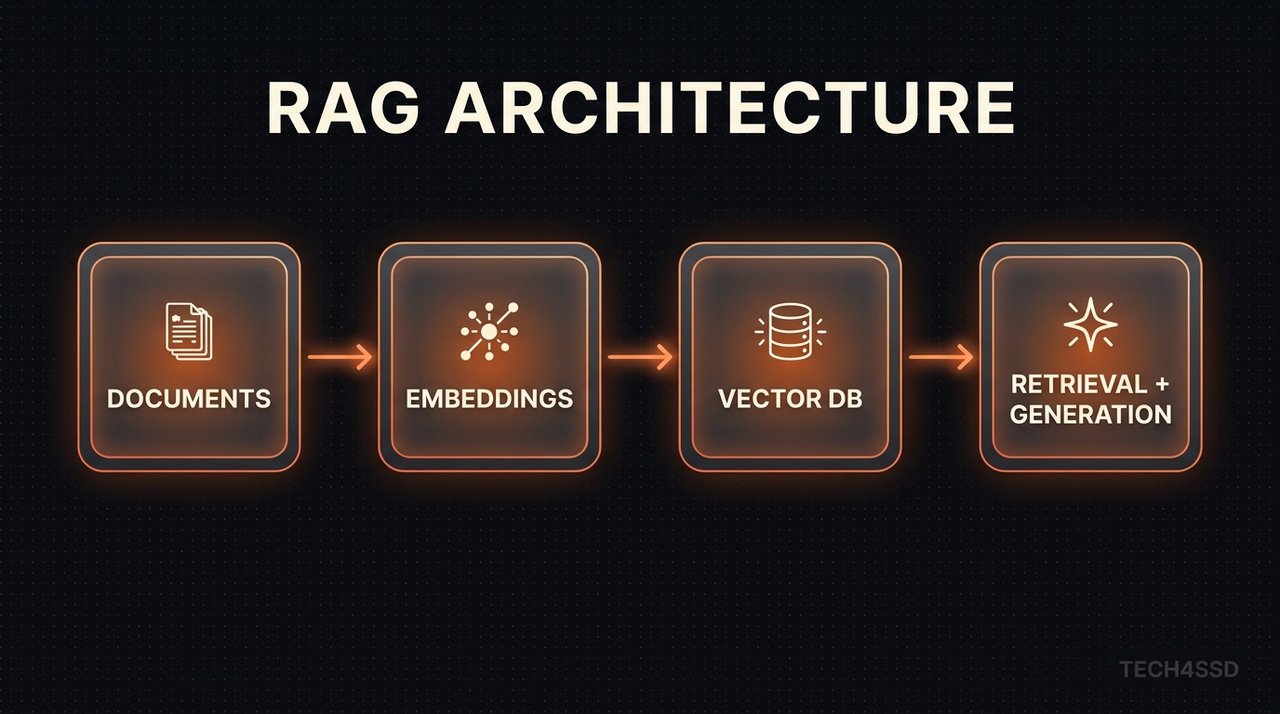
Every RAG system — from a weekend script to a production deployment serving millions — follows the same four-stage pipeline.
1. Documents → Chunks. You take your raw sources (PDFs, Notion pages, support tickets, web crawls) and split them into smaller pieces. Each chunk is small enough to be retrieved precisely, big enough to carry meaning on its own.
2. Chunks → Embeddings. Each chunk goes through an embedding model that converts text into a high-dimensional vector — a numeric fingerprint of the chunk's meaning. Similar meanings produce similar vectors.
3. Embeddings → Vector DB. You store the vectors in a database designed for fast nearest-neighbor search across millions or billions of vectors. This is your retrieval layer.
4. Query → Retrieval → Generation. At runtime, the user's question is embedded the same way, the vector DB returns the top-K most similar chunks, those chunks get pasted into the prompt as context, and the LLM writes an answer grounded in them.
That's it. Four stages. Everything else — reranking, hybrid search, query rewriting, evaluation — is optimization on top of this skeleton.
Building a RAG System (with Python Snippets)
Let's walk through each stage with original, minimal code. These snippets are illustrative — production systems wrap them in error handling, batching, and monitoring — but they show the exact mechanics.
Step 1: Chunk your documents
A clean chunker is the single highest-leverage piece of a RAG pipeline. The boring approach — splitting every 500 characters — destroys semantic boundaries. Smart chunking respects paragraphs and sentences.
def chunk_text(text, target_size=700, overlap=120):
    paragraphs = [p.strip() for p in text.split("\n\n") if p.strip()]
    chunks, current = [], ""
    for p in paragraphs:
        if len(current) + len(p) < target_size:
            current += "\n\n" + p
        else:
            if current:
                chunks.append(current.strip())
            tail = current[-overlap:] if overlap else ""
            current = tail + "\n\n" + p
    if current:
        chunks.append(current.strip())
    return chunks
Notice the overlap argument. A small overlap between consecutive chunks keeps boundary-spanning facts retrievable even when they straddle a split.
Step 2: Embed each chunk
Modern embedding models output 1024-dimensional vectors in milliseconds. We'll use a generic API shape — drop in OpenAI, Voyage, or Cohere as needed.
def embed(texts, client, model="text-embedding-3-large"):
    response = client.embeddings.create(model=model, input=texts)
    return [item.embedding for item in response.data]

chunks = chunk_text(open("docs.md").read())
vectors = embed(chunks, my_embedding_client)
Batch your calls. One request with 100 chunks is dramatically cheaper than 100 requests with one chunk each.
Step 3: Store in a vector DB
For local prototyping you can use SQLite + a vector extension. For anything real, you reach for a managed vector DB. The interface looks roughly the same everywhere — upsert vectors with metadata, query by vector.
records = [
    {"id": f"chunk-{i}", "values": v, "metadata": {"text": t}}
    for i, (t, v) in enumerate(zip(chunks, vectors))
]
index.upsert(records, namespace="docs-v1")
The namespace field is underrated. Use it to separate datasets, environments, or tenants without spinning up new indexes.
Step 4: Retrieve + generate
At query time you embed the question once and ask the DB for the top-K most similar chunks. Then you stuff those chunks into a tightly written prompt.
def answer(question, k=5):
    q_vec = embed([question], my_embedding_client)[0]
    hits = index.query(vector=q_vec, top_k=k, namespace="docs-v1")
    context = "\n\n---\n\n".join(h["metadata"]["text"] for h in hits)

    prompt = (
        "Answer the question using ONLY the context below. "
        "If the answer is not present, say you don't know.\n\n"
        f"CONTEXT:\n{context}\n\nQUESTION: {question}"
    )
    return llm.complete(prompt)
That last instruction — "if the answer is not present, say you don't know" — is the single most important line in a RAG prompt. It's the difference between a system that admits ignorance and one that fabricates citations.
Top RAG Tools 2026
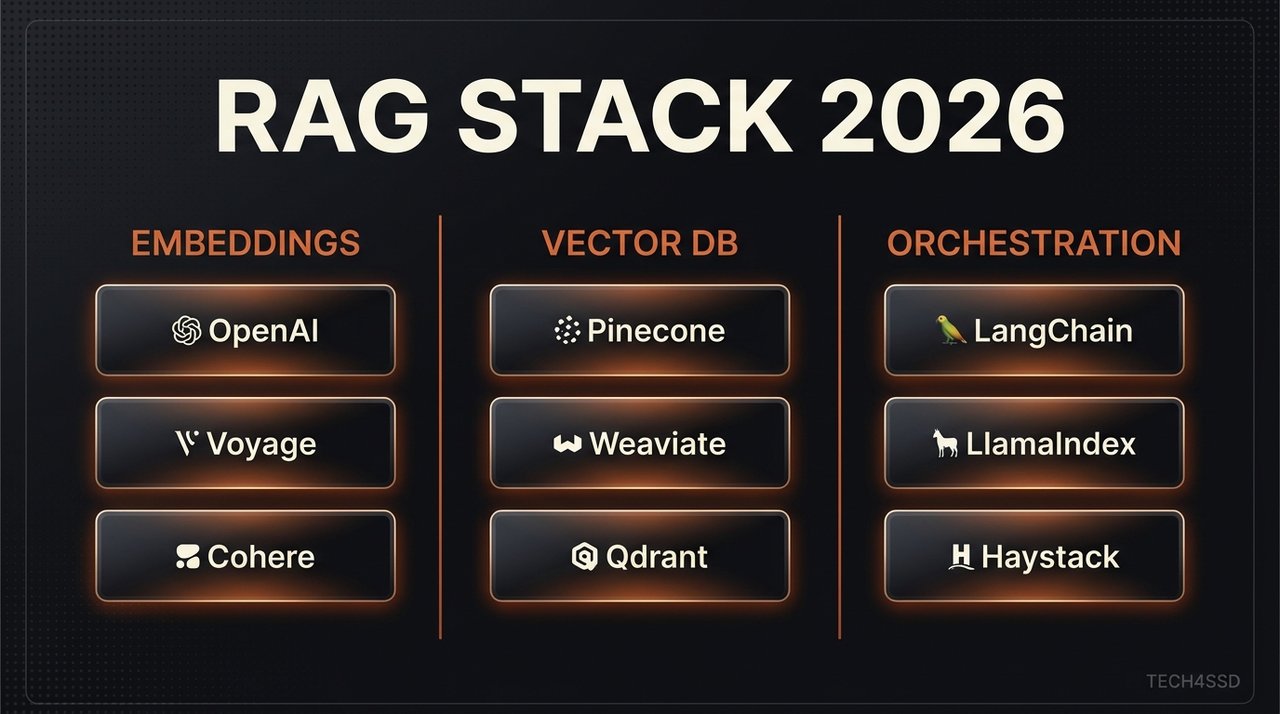
The stack has consolidated. You won't go wrong picking from this shortlist.
Embedding models
- OpenAI text-embedding-3-large — the safe default, strong general performance, easy to swap models without rebuilding.
- Voyage AI voyage-3 — currently the highest retrieval quality on most public benchmarks; the go-to for legal, finance, and code search.
- Cohere embed-v4 — great multilingual coverage; the best pick if your corpus spans many languages.
Vector databases
- Pinecone — fully managed, lowest-friction onboarding, serverless tier that scales to zero. Best if you don't want to run infrastructure.
- Weaviate — open source, built-in hybrid search and multi-tenant features, strong if you want self-hosting plus rich querying.
- Qdrant — Rust-based, blazingly fast filtered search; ideal when retrieval needs to combine vector similarity with strict metadata filters.
Orchestration frameworks
- LlamaIndex — purpose-built for RAG. Great chunking, retrieval, and evaluation primitives. If RAG is your product, start here.
- LangChain — broader agent framework with RAG as one of many capabilities. Pick it if RAG is one feature inside a bigger agent.
- Haystack — production-grade, strong on enterprise patterns like document review and structured pipelines.
Don't overthink the orchestration choice. The retrieval quality of your system is driven 90% by chunking strategy, embedding model, and prompt design — not by the framework you wire them together with.
Common RAG Mistakes
Most "RAG isn't working" complaints trace back to three failures. Fix these and your accuracy jumps overnight.
1. Wrong chunk size. Chunks too small and you lose context; chunks too large and you dilute retrieval. The 500–800 token range is the sweet spot for most knowledge bases. Always include a small overlap so important facts aren't sliced apart.
2. Wrong top-K. Retrieving one chunk leaves the model blind; retrieving fifty drowns it in noise. Start at K=5, evaluate, then tune. Add a reranker if your top-K is messy — a small cross-encoder model can dramatically improve the order of retrieved chunks before they hit the LLM.
3. Sloppy prompt design. If you don't explicitly instruct the model to ground answers in the context and refuse otherwise, it will happily fall back to its training data and hallucinate. Make grounding non-optional in your system prompt and add a "cite the chunk ID" instruction so you can audit answers later.
Bonus mistake: never evaluating. Retrieval quality is measurable. Build a 50-question test set with known correct answers, score your pipeline on it weekly, and treat regressions as bugs. RAG without evals is vibes-based engineering.
Build AI that actually knows your data
Daily RAG, agent, and tooling breakdowns in your inbox. Free.
RAG vs MCP — When to Use Which
This is the question that comes up in every architecture review in 2026. The short answer: RAG retrieves passive knowledge, MCP triggers active tools.
| Dimension | RAG | MCP |
|---|---|---|
| Best for | Q&A over documents | Live actions in tools |
| Data shape | Text, PDFs, web pages | APIs, databases, services |
| Read or write | Read only | Read + write |
| Freshness | As fresh as your last index | Real-time on every call |
| Mental model | Library | Toolbelt |
If you're answering questions like "what's our refund policy?", that's RAG. If you're triggering actions like "refund this order and email the customer", that's MCP. Real production systems use both — RAG for the knowledge layer, MCP for the action layer. If MCP is still fuzzy to you, start with our MCP explained guide and then come back here.
The 2026 RAG Workflow That Actually Ships
Here's the lean playbook I see working across teams I advise:
- Start with one corpus. Don't try to index everything on day one. Pick one knowledge source where bad answers cost real money.
- Use a managed vector DB first. You'll move to self-hosted later if the bill demands it. For now, focus on quality.
- Write an eval set before you write your retriever. 30–50 real questions with known good answers. Score every change.
- Ship retrieval-only first. A search box that returns chunks beats nothing. Generation gets added once retrieval is solid.
- Layer in reranking once the basics work. Don't optimize prematurely — only after evals show retrieval ordering is your bottleneck.
For teams already using AI coding assistants and skill systems, this is where things compound — read our breakdown of Claude Skills for the pattern of plugging a RAG pipeline into a skill-aware agent so the same retriever serves both your chatbot and your dev tools.
FAQ
What does RAG stand for?
Retrieval Augmented Generation. The model retrieves relevant chunks from a knowledge base before generating an answer.
Is RAG dead in 2026 because of long context?
No. Long context complements RAG but doesn't replace it. Cost, latency, and attention degradation still make targeted retrieval the better default for most production workloads.
What's the best vector database for beginners?
Pinecone. Managed, serverless tier, fastest path from zero to a working retriever. Switch to Weaviate or Qdrant when you need more control.
How is RAG different from fine-tuning?
Fine-tuning changes the model's weights. RAG changes what's in the model's prompt. RAG is faster, cheaper, and lets you update your knowledge base in seconds without retraining.
Can I build a RAG system without LangChain or LlamaIndex?
Yes. A working RAG pipeline is roughly 80 lines of Python. Frameworks help when you scale — they're not required to start.
Final Take
RAG isn't a hack or a stopgap. It's the architecture that turns generic models into systems that actually know your business. In 2026 the winners aren't the teams with the biggest context windows — they're the teams with the cleanest chunks, the sharpest embeddings, and the most ruthless evals.
Pick one corpus this week. Stand up Pinecone or Qdrant. Wire it to a model. Measure it. You'll go from "AI is cool but vague" to "AI knows our docs" in a single weekend.
Want AI that actually knows your data?
Subscribe to the Tech4SSD newsletter — daily breakdowns of RAG, agents, MCP, and the tools that make AI ship-ready.
Subscribe Free →
Discussion
Have a question or something to add?
Join the discussion on Blogger